
Updated: 10 November 2026
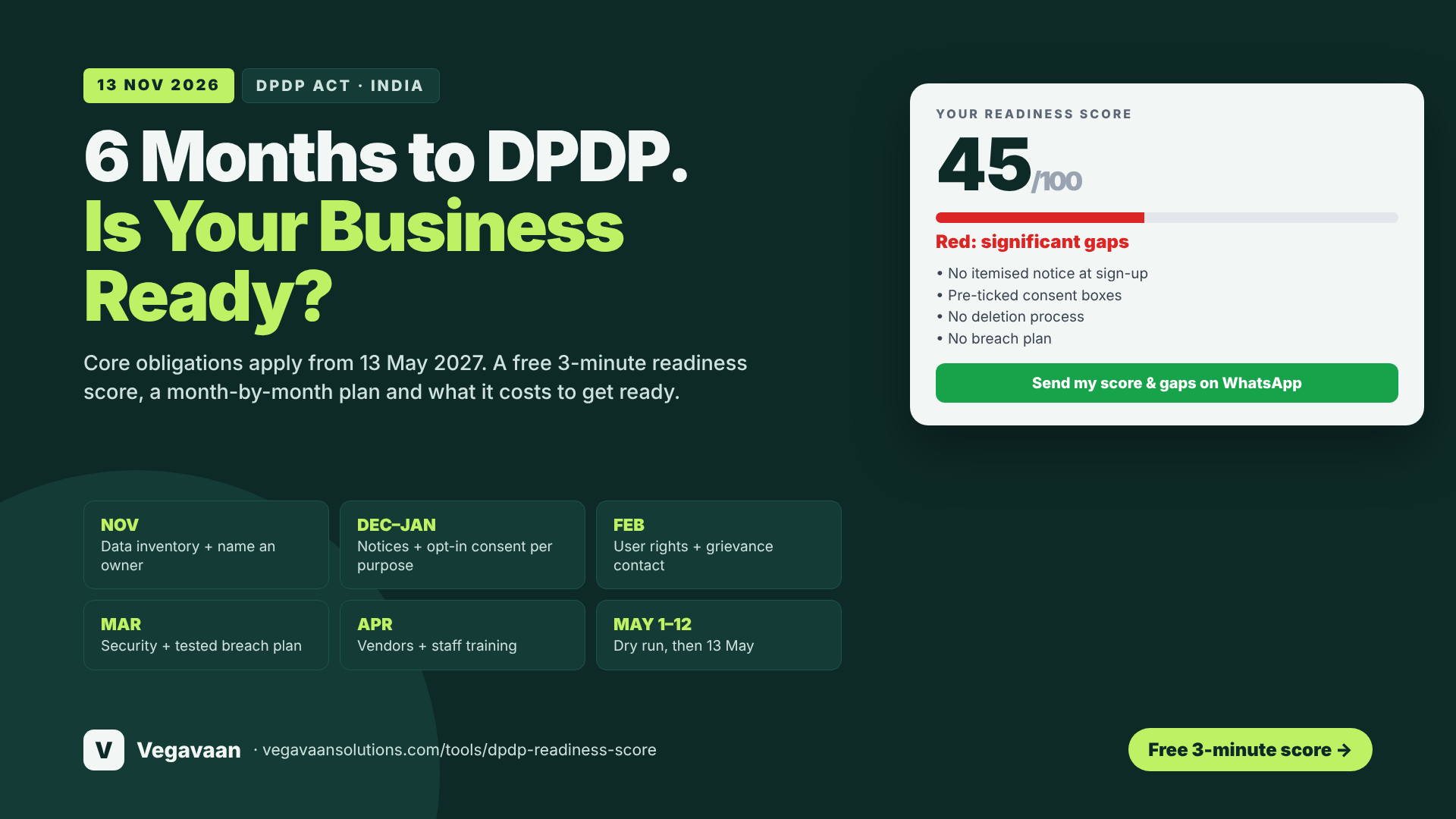
On 13 November 2026, India's businesses cross a quiet milestone: exactly six months until the core obligations of the Digital Personal Data Protection (DPDP) Act apply on 13 May 2027. Six months sounds like a lot. For a company that has never mapped its data, rewritten a consent form or tested a breach plan, it is about the minimum.
Most coverage of DPDP is written for large enterprises and their lawyers. This guide is for the rest of us: the manufacturer with a dealer portal, the clinic with a WhatsApp list, the coaching institute with 4,000 student records in Excel, the agency with client data on a shared drive. It gives you a 3-minute readiness score, a month-by-month plan from now to May, and the mistakes we see most often.
👉 Take the free DPDP Readiness Score
10 questions. 3 minutes. Nothing is stored.
This is a practical guide, not legal advice. Confirm specifics with your legal advisor and the official DPDP Act 2023 and DPDP Rules 2025.
Contents
- Quick answer
- Who this applies to (probably you)
- The 10-question readiness score
- The 6-month plan: November to May
- What it costs to get ready
- 8 mistakes we see every week
- The technical changes most websites and apps need
- Frequently asked questions
Quick answer
From 13 May 2027, any Indian business that collects personal data digitally must give clear itemised notices, take separate opt-in consent per purpose, let people access, correct and delete their data and withdraw consent, publish a grievance contact, delete data when its purpose ends, protect it with reasonable security, keep logs for at least a year, and notify users and the Data Protection Board of breaches. Penalties go up to ₹250 crore per breach category. With six months left, the realistic order is: data inventory in November, notices and consent in December–January, user-rights and grievance process in February, security and breach plan in March, vendor contracts and staff training in April, and a dry run in early May.
Who this applies to (probably you)
DPDP applies to anyone processing digital personal data in India, with limited exemptions for purely personal use and some government functions. In practice, you are covered if you have any of these:
- A website contact form, newsletter or lead form
- A mobile app with sign-up
- A WhatsApp broadcast or customer list
- Customer, patient, student or dealer records in any software or spreadsheet
- Employee data (payroll, Aadhaar copies, HR files)
- CCTV with identifiable footage
- CRM, email marketing or analytics tools
Small businesses get some relief: certain obligations (such as detailed notices and some rights) are lighter for data processed for purely personal or household purposes, and the government may notify exemptions for startups and small entities for specific provisions. Do not plan around exemptions you have not confirmed in writing.
The 10-question readiness score
Our free tool asks ten questions and scores you out of 100. The questions, if you want to self-assess here:
- Do you know every place you collect personal data?
- Does every form show a clear, itemised notice (purpose, withdrawal, complaints)?
- Is consent a separate opt-in per purpose, with no pre-ticked boxes or bundling?
- Can users access, correct, delete their data and withdraw consent through a defined process?
- Do you have a published grievance contact and a response process?
- Do you delete data when its purpose ends, with defined retention periods?
- Do you handle under-18 data with verifiable parental consent (or not at all)?
- Are security basics in place: HTTPS, access control, encryption, backups, one-year logs?
- Do you have a written, tested breach response plan with notification templates?
- Are vendors that hold your data listed and covered by data-protection contract terms?
80+: largely ready; document and train. 50–79: partly ready; six months is enough if you start now. Under 50: significant gaps; begin with the data inventory this month.
The 6-month plan: November to May
| Month | Do this | Output |
|---|---|---|
| November 2026 | Data inventory: every form, app, sheet, tool and vendor that holds personal data; what, why, where, how long. Name one person as DPDP owner. | A one-page data map; a named owner |
| December | Rewrite notices for every collection point: itemised purposes, how to withdraw, how to complain. Decide language(s). Update the privacy policy. | New notices live on website, app, WhatsApp opt-in, offline forms |
| January 2027 | Fix consent: separate opt-in per purpose, no pre-ticked boxes, consent records with timestamp and version. Decide what to do with legacy data collected without proper consent. | Consent flows and consent log in place |
| February | User rights: a process (or self-service) for access, correction, erasure and withdrawal, with timelines. Publish the grievance contact. Define retention per data type. | Rights process, grievance page, retention schedule |
| March | Security and breach readiness: access controls, encryption, backups, one-year logs, a written breach plan with templates for users and the Board, and a table-top test. | Security checklist signed off; tested breach plan |
| April | Vendors and people: list every vendor with personal data, add data-protection terms, confirm their security; train staff; handle children's data and any sector rules. | Vendor register and contracts; training record |
| 1–12 May | Dry run: submit a test access request, a test deletion, a test withdrawal and a simulated breach. Fix what fails. | Evidence file ready for 13 May |
Our earlier DPDP compliance checklist for websites and apps has the detailed item list for each step.
What it costs to get ready
| Business | Typical work | Indicative one-time cost |
|---|---|---|
| Small service business (website + WhatsApp list) | Notices, consent on forms, privacy policy, grievance page, retention rules, basic security review | ₹25,000 – ₹80,000 |
| Business with an app or portal | All of the above plus consent logging, self-service data requests, deletion workflows, log retention, breach plan | ₹80,000 – ₹3 lakh |
| Clinic, school or institute (sensitive or children's data) | Plus parental consent flows, stricter access controls, vendor review, staff training | ₹1 lakh – ₹4 lakh |
| Multi-system company (CRM + ERP + app + marketing) | Data mapping across systems, vendor contracts, security audit (VAPT), automation of deletion and requests | ₹3 lakh – ₹10 lakh+ |
Legal review is additional. Compare these with penalties of up to ₹250 crore for failing security safeguards, and with the simpler cost of losing a customer's trust. You can get a rough figure for your own project with our cost estimator (tick "DPDP compliance pack").
8 mistakes we see every week
- "We have a privacy policy, so we are compliant." A policy page is not an itemised notice at the point of collection, and it is not consent.
- Pre-ticked boxes and bundled consent ("I agree to terms and marketing").
- No way to withdraw. If giving consent took one tap, withdrawing it must be as easy.
- Personal data in consumer AI tools. Staff pasting customer lists into free chatbots. Set a written rule.
- WhatsApp lists built from walk-ins with no consent record.
- Keeping everything forever "in case we need it".
- Vendors nobody has listed: the SMS gateway, the old CRM, the freelancer with database access.
- No breach plan, so the first hour after a breach is spent deciding who to call.
The technical changes most websites and apps need
- Consent layer: separate checkboxes per purpose, versioned consent text, a consent log (who, when, what version, how).
- Data-request flow: a form or account page for access, correction, erasure and withdrawal, with ticketing and timelines.
- Retention automation: scheduled deletion or anonymisation per data type, with exceptions for legal holds.
- Access control and encryption: role-based access, encrypted databases and backups, MFA on admin accounts.
- Logging: access and change logs retained for at least one year, protected from tampering.
- Children's data: age checks and verifiable parental consent where relevant; no behavioural tracking or targeted ads at children.
- Breach tooling: monitoring, an incident template and a contact list ready before you need them.
If your systems run on old PHP or an unsupported CMS, do the security update first; a compliant notice on a hackable site helps nobody. See our cybersecurity guide for Indian businesses.
How Vegavaan can help
Vegavaan Info Solutions builds the technical side of DPDP readiness for Indian businesses: consent layers, data-request flows, retention automation, access controls, logging and breach tooling on your website, app and internal systems, plus a plain-language plan your lawyer can review. Start with the free score; if it is amber or red, book a free gap review and we will map the six months with you.
Take the Readiness Score Book a free gap review
Frequently asked questions
When does the DPDP Act come into force?
The DPDP Rules were notified in November 2025 with a phased timeline. Core obligations for businesses, including notice, consent, user rights, security safeguards and breach notification, apply from 13 May 2027, eighteen months after notification.
Does DPDP apply to small businesses?
Yes, if you process digital personal data. Some provisions may be relaxed for notified categories of startups and small entities, but notice, consent, security and breach obligations should be assumed to apply unless an exemption is confirmed.
What are the penalties under DPDP?
Up to ₹250 crore for failing to take reasonable security safeguards, ₹200 crore for failing to notify a breach or for children's data violations, and other amounts for other breaches, decided by the Data Protection Board.
Is a privacy policy enough for DPDP compliance?
No. You need an itemised notice at each point of collection, separate opt-in consent per purpose, a way for users to exercise their rights and withdraw consent, a grievance contact, retention limits, security safeguards and a breach process.
What is a DPDP readiness score?
A self-assessment that scores your business on ten core requirements: data inventory, notices, consent, user rights, grievance contact, retention, children's data, security, breach plan and vendors. Use it to see where to start.
How long does DPDP readiness take?
For a small business with a website and a few tools, two to three months of part-time work. For companies with apps, portals and multiple systems, four to six months. Starting in November 2026 leaves just enough time.
Conclusion
Six months is enough to get ready, and not enough to postpone. Take the score, name an owner, map your data this month, and follow the month-by-month plan. By May you will have something most of your competitors will not: proof that you take your customers' data seriously.
Want help with the technical work? Talk to Vegavaan.