
Updated: 17 November 2026
Until now, an AI assistant could only tell your customer about your business. Last week, AI assistants started buying from businesses on the customer's behalf. In five days, three things happened that every business with a website should know about:
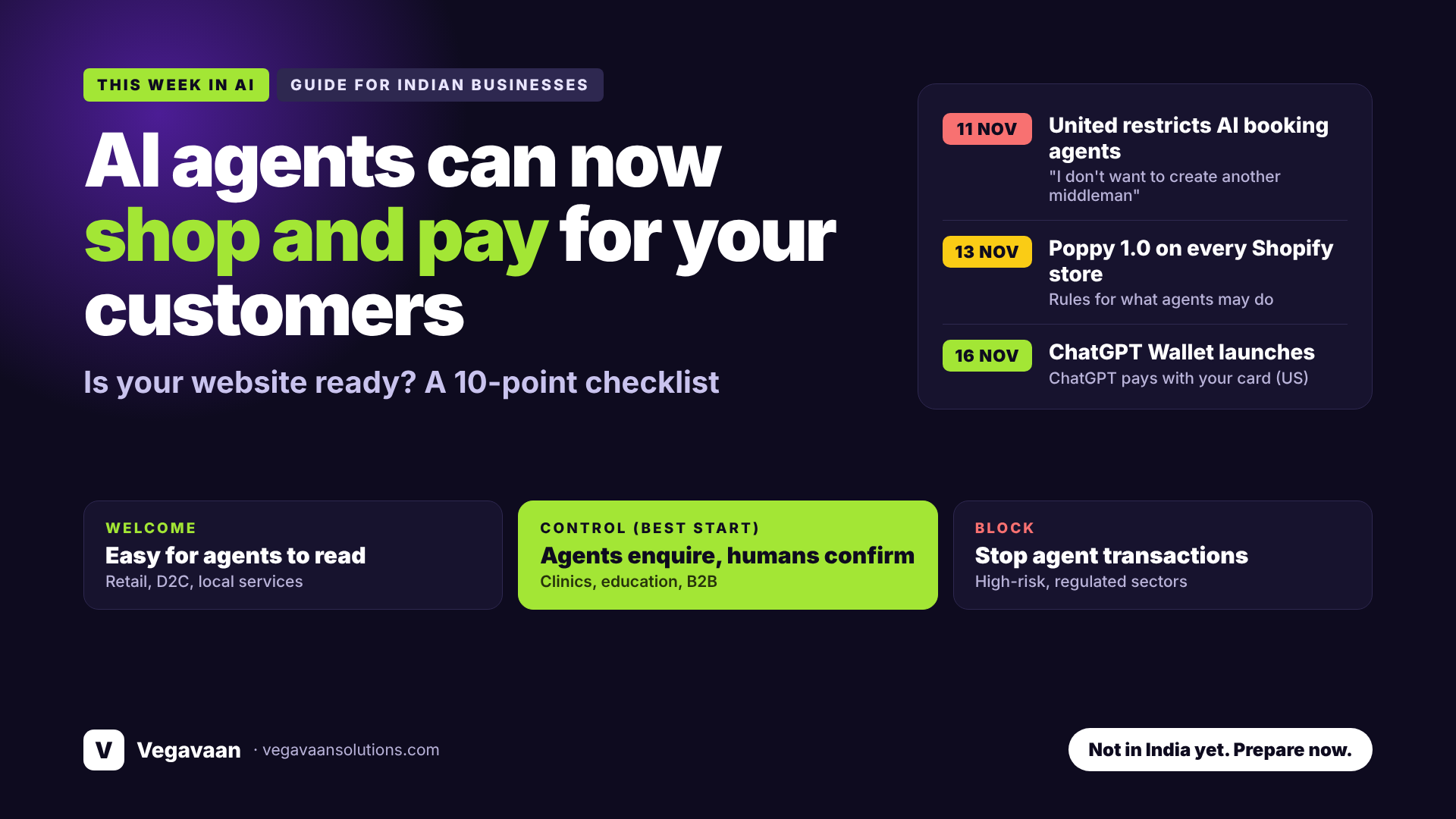
- 11 November: United Airlines said it will block unauthorised personal AI agents from booking its flights.
- 13 November: Sierra released Poppy 1.0, a standard that lets websites tell AI agents what they are allowed to do. Shopify switched it on for every store.
- 16 November: OpenAI launched ChatGPT Wallet, so ChatGPT can pay for purchases with the user's own card after the user approves.
None of this has reached India yet. But Indian businesses have seen this film before: Google search, then WhatsApp Business, then UPI. The businesses that prepared early won. This guide explains in plain language what changed, what it means for an Indian website, and a 10-point checklist to get ready, whether you want AI agents to buy from you or not.
Contents
- Quick answer
- What is an AI shopping agent?
- The three announcements, in one table
- What it means for Indian businesses
- Your choice: welcome, control or block
- Impact by type of business
- 10-point checklist: make your website agent-ready
- Risks to plan for
- Frequently asked questions
Quick answer
AI agents are AI assistants that complete tasks such as searching, comparing, booking and paying on a customer's behalf. In November 2026, OpenAI launched ChatGPT Wallet (US ChatGPT Pro users only, each purchase approved by the user), Sierra released the Poppy 1.0 standard (enabled on every Shopify store and used by Meta's Muse assistant), and United Airlines moved to block unauthorised agents. None of this is live in India yet, but Indian businesses should prepare now: make prices, stock, policies and contact details clear and machine-readable, decide whether to allow, limit or block AI agents, make sure your firewall does not block legitimate ones by accident, and keep a human approval step for anything risky.
What is an AI shopping agent?
Think of it as a very capable personal assistant who lives in an app. Today a customer searches, opens five websites, compares and then buys. With an agent, the customer says: "Order a 1.5 ton inverter AC under ₹40,000 with installation this week" or "Book a dermatologist near me for Saturday morning", and the assistant does the searching, comparing and filling in, and then asks the customer to approve.
That changes who visits your website. Some of your "visitors" will be software acting for a real customer. If that software cannot understand your website, it simply moves on to a competitor whose website it can understand.
The three announcements, in one table
| Date | Who | What happened | Why it matters |
|---|---|---|---|
| 11 Nov 2026 | United Airlines | Said it is restricting "unauthorized, third-party personal AI agents or assistants" on its own platforms and through travel sites. Reasons given: account security, unintended purchases or changes, and regulatory rules. CEO Scott Kirby: "I don't want to create another middleman." | Shows that businesses can, and will, say no |
| 13 Nov 2026 | Sierra, with Meta and Shopify | Released Poppy (Personal Agent Protocol) 1.0, a standard for an AI agent to say who it is and for a business to set what it may do. Shopify enabled it for every store. Meta's Muse looks for it first on every site. 100+ design partners | A common "rulebook" between websites and agents is forming |
| 16 Nov 2026 | OpenAI, with Visa, Mastercard and American Express | Launched ChatGPT Wallet for US ChatGPT Pro users. Each purchase is reviewed and confirmed with Face ID or fingerprint; the merchant receives a payment token, not the card number | The payment step, the hardest part, now exists |
OpenAI also told businesses what it wants from them: claim their listing in ChatGPT, upload up-to-date product feeds, and set up firewalls to recognise signed requests from legitimate agents.
What it means for Indian businesses
Today: ChatGPT Wallet is US-only, and no India launch has been announced. Indian payments also work differently (UPI, and card rules that require extra authentication), so an Indian version may look different.
What is already true in India: your customers are using ChatGPT and other assistants to research products and services before they buy. If an assistant cannot read your prices, service area or availability, you are already being left out of the shortlist, even before agents start paying.
What changes next: research, then booking, then buying. Each step moves more of the decision from your website's design to your website's data. A beautiful website with prices hidden in images and enquiry-only forms will be invisible to an agent. A plain website with clear, structured information will be easy to choose.
If you sell on Shopify, Poppy is already switched on for you. If you run a custom website, which most Indian service businesses do, nothing happens automatically. That is the gap this checklist closes.
Your choice: welcome, control or block
There is no single right answer. United and Shopify made opposite choices in the same week.
| Approach | What it means | Good for |
|---|---|---|
| Welcome | Make your website easy for agents to read and act on | Retail, D2C, local services, B2B suppliers with standard products, anyone who wants more enquiries |
| Control | Agents can search and enquire, but a human must confirm bookings, payments and account changes | Clinics, finance, education, travel, high-value orders: most Indian businesses |
| Block | Stop automated agents from transacting, as United did | Businesses with strict regulation, fraud risk, or a strong reason to keep the customer relationship direct |
For most Indian small and mid-sized businesses, "Control" is the sensible starting point: be fully visible, let agents gather information and start an enquiry, and keep a person in charge of the final step.
Impact by type of business
| Business | What an agent will try to do | What to prepare |
|---|---|---|
| Online store / D2C | Compare price, stock, delivery time and return policy; place an order | Accurate product feed, live stock, clear return and delivery pages |
| Clinic or hospital | Find a doctor, check timings and fees, book a slot | Doctor names, specialities, timings and fees as text; booking with human or patient confirmation |
| Coaching / education | Compare courses, fees, batch dates; register | Fee tables, batch calendar, refund policy in plain text |
| Hotel / travel | Check availability, compare price, book | Direct rates on your own site, clear cancellation terms |
| Manufacturer / B2B supplier | Shortlist suppliers, check specifications and minimum order, request a quote | Spec sheets as text (not only PDFs), MOQ, lead time, a quote form that works without a phone call |
| IT / services company | Shortlist vendors, compare price ranges and case studies, book a call | Price ranges, service pages per service, a calendar booking link |
10-point checklist: make your website agent-ready
- Put the facts in text, not images. Prices, timings, address, service area, stock and policies must be readable text. An agent cannot reliably read a price written inside a banner.
- Show prices or price ranges. "Call for price" removes you from every comparison an agent makes. A range is better than nothing.
- Add structured data (schema markup). Product, Offer, LocalBusiness, MedicalClinic, Course, FAQ and similar markup tells machines exactly what each page is. It also helps normal Google search.
- Keep one source of truth. Your website, Google Business Profile, marketplace listings and any product feed must show the same price and the same timings. Agents compare, and mismatches look like mistakes.
- Make key pages work without heavy scripts. If your prices or products appear only after complex JavaScript runs, some automated readers will see an empty page.
- Write clear policy pages. Delivery, returns, cancellation, refund and warranty in simple sentences. Agents check these before recommending you.
- Decide your rules in robots.txt and your firewall. Know which AI crawlers and agents you allow. Make sure an over-strict firewall or bot-protection setting is not blocking legitimate assistants by accident. Our guide on controlling AI bots with robots.txt explains the options.
- Make enquiry and booking forms simple. Few fields, clear labels, no "call us to proceed" dead ends, and a confirmation by email or WhatsApp.
- Keep a human approval step for risky actions. Payments above a limit, account changes, medical bookings and refunds should need confirmation from the customer or your team.
- Log and label agent traffic. Ask your developer to record when orders or enquiries come from automated agents, so you can measure them and spot misuse.
For larger businesses: look at an API or catalogue feed for agents, and at the emerging standards (Poppy for agent identity and permissions; product feeds for ChatGPT; signed agent requests). These are still early and changing, so build on your own clean data first and add a standard when it matters for your customers.
Risks to plan for
- Unintended orders: the reason United gave. Keep confirmation steps for anything that costs money or changes an account.
- Fake "agents": scrapers and bots can pretend to be AI assistants. Rate limits and verification still matter.
- Price scraping by competitors: being readable also means being easy to compare. That is the trade-off of visibility.
- Personal data: agents may pass customer details to your forms. Under India's DPDP rules you still need notice, consent and safe handling. See our DPDP checklist.
- Losing the relationship: United's CEO worried about "another middleman". Collect customer consent for follow-ups so the relationship stays yours even if the first order came through an agent.
How Vegavaan can help
Vegavaan Info Solutions helps Indian businesses get ready for AI search and AI agents without rebuilding everything. We audit what an AI assistant can actually read on your website, fix prices and key facts hidden in images or scripts, add structured data, clean up booking and enquiry forms, set sensible rules for AI crawlers and agents, and, where useful, build an API or catalogue feed. For new projects, our website development and AI solutions teams build agent-ready from day one.
Send us your website address and we will tell you what an AI assistant sees today, and the three fixes that matter most.
Frequently asked questions
What is an AI shopping agent?
An AI assistant that searches, compares, books or buys on a customer's behalf, usually asking the customer to approve before paying.
What is ChatGPT Wallet?
A payment feature OpenAI launched in November 2026 that lets ChatGPT complete purchases with the user's own card. Each purchase is reviewed and confirmed by the user with Face ID or a fingerprint, and the merchant receives a payment token instead of the card number.
Is ChatGPT Wallet available in India?
No. At launch it is for ChatGPT Pro subscribers in the US with eligible US-issued cards. No India date has been announced.
What is Poppy (Personal Agent Protocol)?
A standard released by Sierra on 13 November 2026, built with Meta, that lets an AI agent identify itself to a business and lets the business set what the agent may do. Shopify has enabled it on every store and Meta's Muse assistant checks for it on every site.
Why did United Airlines block AI agents?
United cited risks from sharing account credentials, unintended purchases or account changes, and conflicts with aviation rules. Its CEO also said he did not want "another middleman".
Should my business block AI agents?
Most businesses should not block them completely. A better default is to let agents read information and start enquiries, and to keep a human confirmation step for payments, bookings and account changes.
How do I know if AI assistants can read my website?
Check whether prices, timings and policies are plain text, whether pages load without heavy scripts, whether you have structured data, and whether your robots.txt or firewall blocks AI crawlers. A website audit can test this directly.
Does this affect normal Google SEO?
Mostly in a good way. Clear text, structured data, consistent information and fast pages help both Google search and AI assistants.
Conclusion
For twenty years, websites were built for people who click. From now on they also need to work for software that reads, compares and acts for those people. India is not there yet, but the direction is clear and the preparation is ordinary good practice: clear facts in plain text, honest prices, simple forms, sensible rules and a human in charge of the risky step. Do that now, and when AI agents arrive in Indian shopping and booking, your business will be the one they can choose.
Want to see what an AI assistant sees on your website today? Talk to Vegavaan.
Sources: The Paypers: OpenAI launches ChatGPT Wallet for agent payments (16 Nov 2026); Sierra: Releasing Personal Agent Protocol 1.0; Shopifreaks: Shopify turns on Poppy for every store; Skift: United Airlines moves to block personal AI agents (11 Nov 2026).