
Updated: 14 November 2026
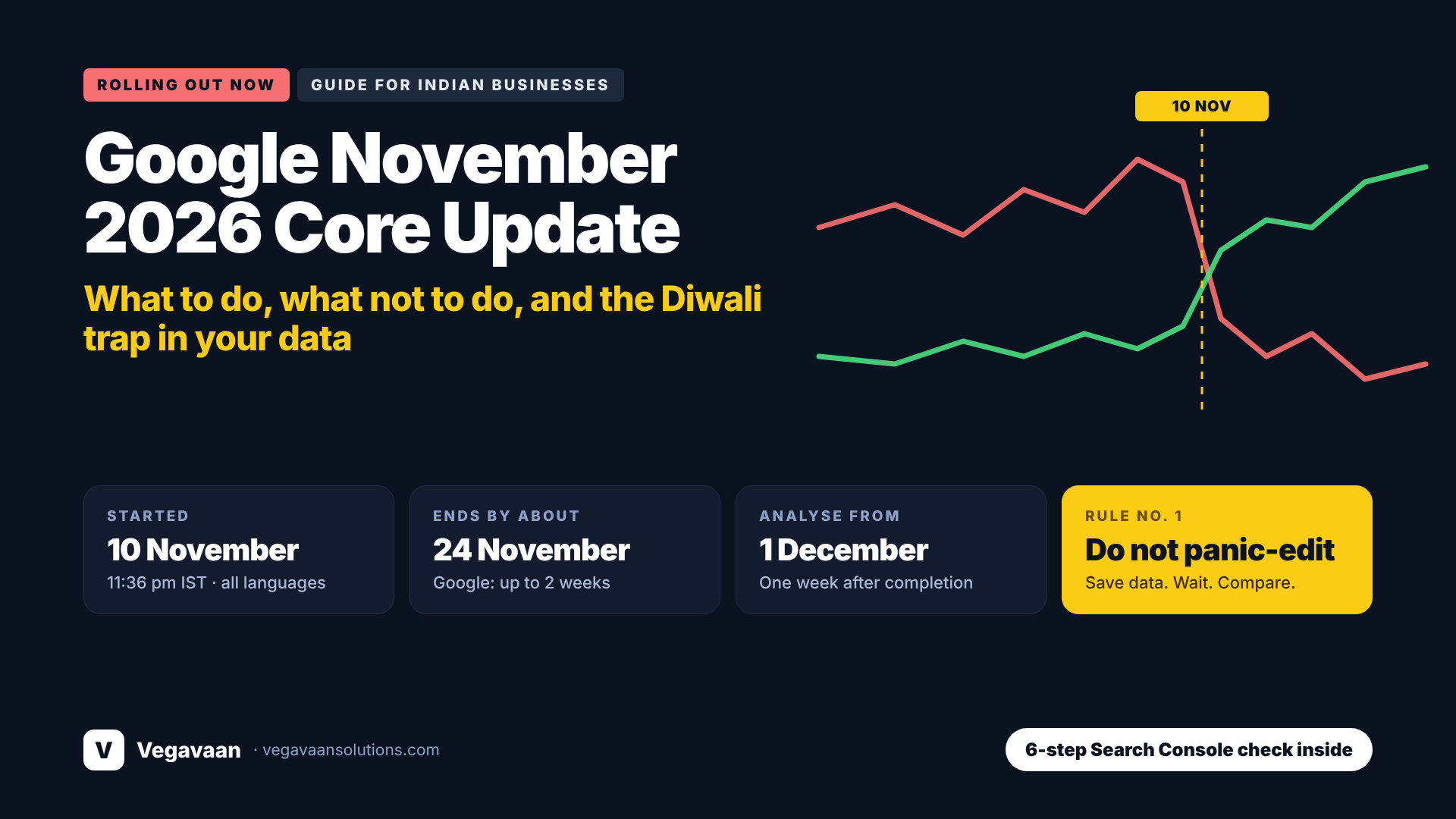
If your website traffic or enquiries have looked strange since Tuesday, you are not imagining it. Google started rolling out its November 2026 core update on 10 November, and rankings are moving for websites across the world, including India. Some pages are climbing, some are falling, and many will change position more than once before the rollout ends.
Most articles about this update are written for American online stores worried about Black Friday. This one is written for Indian businesses: service companies, clinics, manufacturers, coaching institutes, local shops and startups. It explains what has happened, what you should and should not do this week, and the one mistake Indian websites will make when they measure the impact: comparing against Diwali week.
Contents
- Quick answer
- What Google has confirmed so far
- What a core update is, in plain language
- The Diwali trap: why Indian sites will misread their numbers
- 5 things not to do during the rollout
- How to check if you are affected: 6 steps in Search Console
- Diagnosis table: what your drop is telling you
- What to improve after the rollout ends
- Does this change AI Overviews and AI Mode?
- Your calendar: 14 November to 15 December
- Frequently asked questions
Quick answer
Google began the November 2026 core update on 10 November 2026 (11:36 pm IST). It applies to all countries and languages and may take up to two weeks, so it should finish by about 24 November. Do not rewrite or delete pages while it is rolling out. Save your Search Console data now, wait until at least one week after Google says the rollout is complete, and then compare. Indian websites should be careful: the week just before the update (3 to 9 November) was Diwali week, so it is not a normal baseline. A core update is not a penalty; if your pages dropped, the fix is better and more useful content, not a technical trick.
What Google has confirmed so far
| Question | What we know |
|---|---|
| When did it start? | 10 November 2026, 10:06 am Pacific time, which is 11:36 pm IST |
| Who is affected? | All countries and all languages, including Hindi and other Indian languages |
| How long will it take? | Google says up to 2 weeks, so until about 24 November |
| What is it for? | Google calls it "a regular update designed to better surface relevant, satisfying content for searchers from all types of sites" |
| Any new rules? | No. Google has published no new guidance with this update |
| Which update is this? | The third core update of 2026, after March (27 Mar to 8 Apr) and May (21 May to 2 Jun) |
Google also ran three spam updates this year, the most recent finishing on 8 October 2026. So if your traffic fell in late September or early October, that is a different event with different causes.
What a core update is, in plain language
Several times a year, Google adjusts how it judges which pages best answer a search. It is like a teacher re-marking every answer sheet with a slightly improved marking scheme. Nobody is being punished; some answers simply score higher under the new scheme, so others move down.
Three things follow from that:
- It is not a penalty. There is no message in Search Console and nothing to "appeal".
- It does not target your site. Google says core updates do not single out specific sites or pages.
- A drop does not always mean something is broken. It can mean a competitor's page is now judged more useful than yours for that search.
The Diwali trap: why Indian sites will misread their numbers
Google's standard advice is to compare a week after the update with a week before it. For this update, the week before is 3 to 9 November. In India, that was Diwali week (Diwali fell on 8 November).
That week was not normal for almost any Indian website:
| Type of website | What usually happens in Diwali week | What you might wrongly conclude |
|---|---|---|
| B2B, IT services, manufacturers, consultants | Searches and enquiries fall because offices are closed | "The update increased our traffic" when it only returned to normal |
| Online stores, gifts, sweets, electronics, fashion | Searches and sales peak | "The update destroyed our traffic" when the festival simply ended |
| Clinics, coaching, local services | Mixed; many see a dip for a few days | Either of the above |
What to do instead:
- Use 27 October to 2 November as a second baseline alongside 3 to 9 November.
- Check the same pages against last year, remembering Diwali 2025 was on 20 October, so match festival week to festival week, not date to date.
- Look at average position, not only clicks. Festivals change how many people search; they do not change where you rank. If position held steady and clicks moved, it is the season, not the update.
5 things not to do during the rollout
- Do not rewrite, merge or delete pages in a panic. Rankings can move several times before the rollout finishes. If you change pages now, you will never know what caused what.
- Do not change URLs, your theme or your domain. Postpone redesigns and migrations until December.
- Do not buy backlinks or "core update recovery" packages. Nobody can reverse a core update with a trick, and paid links can cause real damage.
- Do not change publish dates to make old articles look new. Cosmetic changes do not help.
- Do not judge by one day. One bad Tuesday is noise. A two-week trend is a signal.
What you can safely do now: fix genuine errors (broken pages, slow loading, wrong phone numbers), keep publishing useful content as planned, and record your data.
How to check if you are affected: 6 steps in Search Console
Google Search Console is free. If you have not set it up, our guide on why a website is not showing on Google explains how.
- Save your baseline today. Open Performance → Search results. Set the date range to 27 October to 9 November and export the Pages and Queries tables.
- Mark the date. Note 10 November in your analytics, CRM or even a diary, so that six months from now you remember why the graph changed.
- Wait. Google's advice is to wait at least one week after the rollout is complete. If it ends on 24 November, analyse from about 1 December.
- Compare. Use the Compare option: the first full week after completion against your baseline weeks.
- Sort by biggest change. In the Pages tab, sort by the difference in clicks. List the 10 pages that lost the most and the 10 that gained the most.
- Read the queries for each losing page. Search those queries yourself in an incognito window and open the pages that now rank above you. Ask honestly: is theirs more complete, more current or more trustworthy?
A simple log is enough:
| Page | Clicks before | Clicks after | Position before | Position after | Who ranks above us now | What they do better |
|---|---|---|---|---|---|---|
| /services/web-design | ||||||
| /blog/your-top-article |
Diagnosis table: what your drop is telling you
| What you see | Most likely cause | What to do |
|---|---|---|
| Traffic fell 80% or more overnight on every page | Probably not the update: site down, "noindex" added by mistake, hosting or domain problem | Check the site loads, check Pages → indexing report, call your developer today |
| Clicks down, average position unchanged | Fewer people searching (after Diwali) or an AI answer taking the click | No ranking problem. See our guide on traffic lost to AI search |
| A few blog articles dropped, service pages stable | Those articles are thinner or older than competing pages | Improve those articles after the rollout |
| Whole site slipped a few positions | Overall trust and quality judged lower than competitors | Work through the improvement list below; this takes weeks, not days |
| Traffic dropped before 10 November | Not this update. Possibly the September spam update, a site change or the season | Match the drop date to what changed on your site |
| Traffic went up | Your pages were judged more useful | Note which pages gained and write more like them |
What to improve after the rollout ends
Google's long-standing advice after a core update is to focus on content made for people, not for search engines. In practice, for an Indian business website, that means:
- Answer the question first. Put a direct answer in the first few lines, then explain. Do not make readers scroll past a long introduction.
- Add what only you know. Real prices in rupees, your own photos, timelines from actual projects, local details. This is what copied and generic content cannot offer.
- Show who is behind the page. A real author name, an About page, address, phone number and GST or registration details where relevant. Do not invent author profiles.
- Update what is out of date. Old prices, old rules, dead links and "2024" in the text all tell a reader the page is neglected. Change the content, not just the date.
- Merge pages that compete with each other. Five thin articles on one topic usually lose to one complete guide.
- Remove filler. If a paragraph exists only to add words or repeat a keyword, delete it.
- Fix the experience. Fast loading on a mobile phone, readable text, no pop-up covering the content.
- If you use AI to write, edit like a human. Check every fact, add your own experience and remove anything you would not say to a customer in person.
How long does recovery take? There is no fixed answer. Some improvements show within days or weeks as Google re-crawls your pages; larger changes in how Google judges a whole site can take months and may only show clearly around a later core update. Anyone promising recovery in seven days is selling something.
Does this change AI Overviews and AI Mode?
Google has published nothing specific about AI answers for this update. What Google has said in general still applies: to appear as a supporting link in AI Overviews or AI Mode, a page needs to be indexed and eligible to appear in normal Search with a snippet. There is no special AI file or markup to add.
So the two are connected. Pages that rank well in normal search are the pool AI answers draw from. If this update moves your rankings, your visibility in AI answers can move with it. More on this in our guide to SEO in the age of AI search.
Your calendar: 14 November to 15 December
| When | What to do |
|---|---|
| Today | Export Search Console data for 27 October to 9 November. Note 10 November as the start date. Fix only genuine errors. |
| Until about 24 November | No big changes. Watch weekly, not daily. Check Google's Search Status Dashboard for the "completed" notice. |
| About 1 December | Compare the first full week after completion with your baselines. List the top 10 losing and gaining pages. |
| 1 to 7 December | Study who outranks you on the losing pages. Decide: improve, merge or leave. |
| 8 to 15 December | Improve the top five losing pages properly. Then continue, five pages at a time. |
How Vegavaan can help
Vegavaan Info Solutions helps Indian businesses understand what actually happened to their website and fix the right things. We read your Search Console data, separate the core update from seasonal and technical causes, review the pages that lost ground against the ones that replaced them, and give you a short, prioritised plan. Where needed, we handle the website work too: speed, mobile experience, structure and content that answers real customer questions.
Get a core update impact check
Send us your website address and we will tell you plainly whether you have a problem or just a post-Diwali dip.
Frequently asked questions
When did the Google November 2026 core update start?
On 10 November 2026 at 10:06 am Pacific time, which is 11:36 pm Indian time. Google says the rollout may take up to two weeks.
When will the November 2026 core update finish?
By about 24 November 2026 if it takes the full two weeks. The March and May 2026 core updates each took about 12 days. Google posts a completion notice on its Search Status Dashboard.
Is a core update a penalty?
No. It is a broad change in how Google evaluates content. Pages are re-assessed against each other; nobody is individually punished and there is nothing to appeal.
My traffic dropped after 10 November. What should I do?
Save your data, avoid big changes until the rollout ends, then compare a full week after completion with a week before. If specific pages dropped, improve their usefulness. If everything dropped overnight, check for a technical fault first.
Why is Diwali a problem when measuring this update in India?
The week before the update, 3 to 9 November, was Diwali week, when search behaviour in India is unusual. Use 27 October to 2 November as an extra baseline and compare average position, not only clicks.
How long does it take to recover from a core update?
It varies. Some improvements show in days or weeks; broader recovery can take months and may only be clear around a later core update. There is no guaranteed timeline.
Does the core update affect AI Overviews and AI Mode?
Google has not said so specifically. But pages must be indexed and eligible for normal Search to be linked in AI answers, so changes in ranking can affect AI visibility too.
Should I stop publishing new content during the update?
No. Keep publishing useful content as planned. Only avoid large changes to existing pages, URLs and site structure until the rollout is complete.
Conclusion
A core update feels like an emergency, but the right response this week is calm: save your numbers, leave your pages alone, and wait for the rollout to finish. For Indian websites, remember that Diwali week sits right before this update, so check positions and not only clicks before you decide whether you won or lost. Then spend December improving the pages that matter, one honest comparison at a time.
Want a second pair of eyes on your data? Talk to Vegavaan.
Sources: Google Search Status Dashboard; Google Search Central: core updates and your website; Search Engine Journal: Google's November 2026 core update starts rolling out.