
Updated: October 2026
Most small and mid-sized businesses in India do not have an IT budget. They have IT surprises: a laptop dies, a website gets hacked, a software renewal doubles, or a new law suddenly needs a website change. Each one is paid for in a rush, usually at a higher price.
2027 is a year when that approach becomes expensive. India's DPDP data protection obligations apply from 13 May 2027, older software is running out of security updates, critical flaws like PHP2Shell are being found faster with AI, and almost every competitor is adding AI and automation.
This guide shows you how to build a simple, realistic IT budget for 2027, whether your year starts in January or you plan for FY 2027-28 starting in April. It includes the 8 budget categories every business needs, a sample budget for a 25-person company, the must-fund items for 2027 and ways to cut costs without cutting safety.
Contents
- Quick answer
- Why 2027 needs a proper IT budget
- The 8 categories of an IT budget
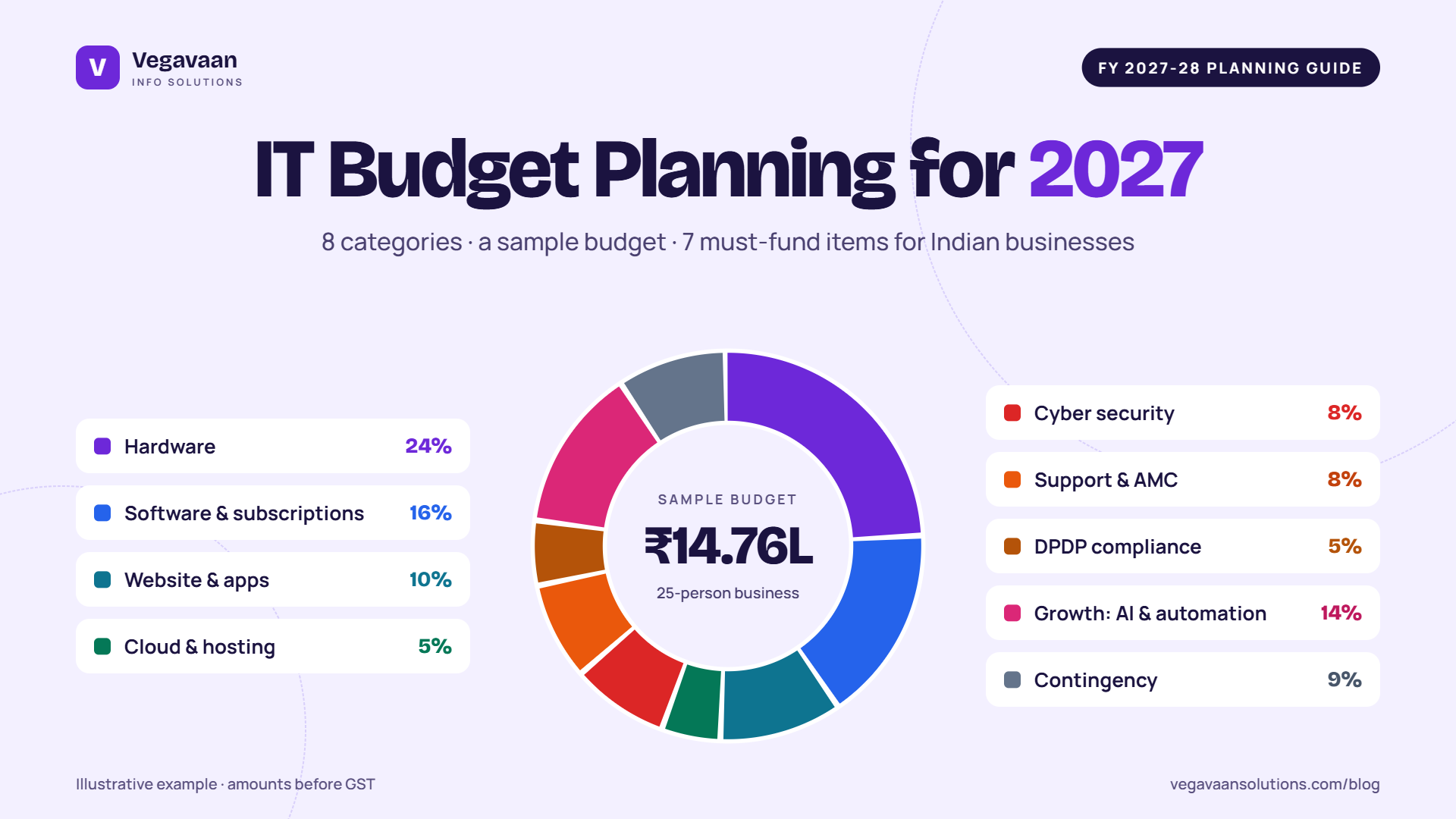
- Sample IT budget for a 25-person business
- 7 must-fund items for 2027
- How to build your budget in 6 steps
- 10 ways to cut IT costs safely
- Frequently asked questions
Quick answer
A good IT budget for 2027 covers eight areas: hardware, software subscriptions, website and apps, cloud and hosting, cyber security, support and maintenance, compliance, and growth projects such as AI and automation. Start by listing everything you already pay for, add the 2027 must-fund items (DPDP compliance, security, replacing unsupported software), set aside 10–15% as a contingency, and review the budget every quarter.
Why 2027 needs a proper IT budget
- DPDP Act deadline: from 13 May 2027, websites and apps that collect personal data need proper notices, consent, security safeguards and breach reporting. Read our DPDP compliance checklist.
- Unsupported software is now a real risk: Windows 10 reached end of support in October 2025, and PHP 8.1 and older versions no longer receive regular security updates. When critical flaws like PHP2Shell appear, unsupported systems stay exposed.
- Attacks move faster: AI is helping researchers and attackers find vulnerabilities faster, so patching and monitoring need dedicated time and money.
- AI is becoming a competitive basic: chatbots, document automation and AI agents are now affordable for small businesses, but only if you plan for them.
- Subscriptions creep up: software costs grow quietly as seats, plans and add-ons are added through the year.
The 8 categories of an IT budget
| # | Category | What it includes |
|---|---|---|
| 1 | Hardware | Laptops, desktops, phones for staff, printers, network equipment, replacements for old devices |
| 2 | Software and subscriptions | Email and office suite, accounting, CRM, design tools, AI tools, antivirus |
| 3 | Website and apps | Domain, website updates, new pages, mobile app maintenance, SEO |
| 4 | Cloud and hosting | Web hosting, cloud servers, storage, backups, email hosting |
| 5 | Cyber security | Firewall, endpoint protection, MFA, security audits (VAPT), staff training |
| 6 | Support and maintenance | IT support, annual maintenance contracts (AMC), patching, repairs |
| 7 | Compliance | DPDP readiness, consent and privacy updates, data retention, legal review |
| 8 | Growth projects | AI chatbots, automation, custom software, new apps, data dashboards |
Add a contingency of 10–15% on top for the surprises that will still happen.
Sample IT budget for a 25-person business
This is an illustrative example to show how a budget can be structured, not a benchmark. Your numbers will depend on your industry, team and existing systems. Prices are before GST (most IT services in India attract 18% GST).
| Category | Example items | Example annual amount |
|---|---|---|
| Hardware | Replace 6 old laptops, 1 network upgrade | ₹3,60,000 |
| Software and subscriptions | Email/office suite, accounting, CRM, AI tools for the team | ₹2,40,000 |
| Website and apps | Website updates, SEO, app maintenance | ₹1,50,000 |
| Cloud and hosting | Hosting, backups, cloud storage | ₹72,000 |
| Cyber security | Endpoint protection, MFA, one VAPT audit, staff training | ₹1,20,000 |
| Support and maintenance | AMC with an IT partner | ₹1,20,000 |
| Compliance | DPDP website and process updates | ₹80,000 |
| Growth projects | WhatsApp AI chatbot or one automation project | ₹2,00,000 |
| Subtotal | ₹13,42,000 | |
| Contingency (≈10%) | Unplanned repairs, urgent fixes | ₹1,34,000 |
| Total | ₹14,76,000 |
For realistic project prices, see our guides to website development cost, app development cost and AI agent cost in India.
7 must-fund items for 2027
- DPDP compliance for your website and apps: consent, notices, data requests and security before 13 May 2027.
- Replace unsupported software and devices: old Windows versions, old PHP versions, outdated plugins and unsupported servers.
- Multi-factor authentication everywhere: email, banking, admin panels and cloud accounts.
- Tested backups: offline or separate copies, and an actual restore test at least twice a year.
- One security audit (VAPT) of your website, apps and network.
- Patch management: someone responsible for applying critical updates within a day, through an AMC or internal role. Read our cybersecurity guide for Indian businesses.
- One AI or automation project with clear ROI: for example a WhatsApp AI chatbot or invoice automation, with security rules from day one.
How to build your budget in 6 steps
- List what you already pay for. Go through bank statements and card bills for the last 12 months and list every IT payment: subscriptions, hosting, domains, repairs, vendors.
- List your assets. Every laptop, phone, server, website, app and software licence, with its age and whether it is still supported.
- Mark the risks. Highlight anything unsupported, unpatched, without backups or without MFA.
- Add 2027 must-funds from the list above.
- Choose one or two growth projects with a clear goal, such as saving 20 hours a week or replying to every lead within 5 minutes.
- Add contingency and review quarterly. Compare actual spending with the plan every three months and adjust.
10 ways to cut IT costs safely
- Cancel unused software seats and duplicate tools
- Switch to annual billing for tools you will definitely keep
- Right-size cloud servers and delete unused storage and test servers
- Standardise laptops and software to simplify support
- Use an AMC instead of paying for emergency repairs each time
- Automate repetitive admin work instead of hiring for it
- Set spending limits and alerts on cloud and AI accounts
- Negotiate multi-year renewals for core software
- Keep domain and hosting accounts in your company's name to avoid lock-in
- Never cut backups, MFA or patching: those are the cheapest insurance you can buy
How Vegavaan can help
Vegavaan Info Solutions can review your current IT setup and help you build a practical 2027 IT plan and budget, then deliver the projects in it: IT consulting, websites, apps, cloud, cyber security and AI solutions, with annual maintenance so critical updates are never missed.
👉 Book a free 2027 IT budget review.
Frequently asked questions
How much should a small business spend on IT?
There is no single right number. It depends on your industry, team size and how digital your business is. The best approach is to list your current costs, add the must-fund items for security and compliance, include one growth project and keep a 10–15% contingency.
What should be included in an IT budget?
Hardware, software subscriptions, website and apps, cloud and hosting, cyber security, support and maintenance, compliance and growth projects such as AI or automation, plus a contingency for unexpected costs.
When should Indian businesses plan their IT budget?
Businesses following the financial year should plan between January and March for FY 2027-28, which starts on 1 April. Calendar-year businesses should finalise their plan in November or December.
Do I need to budget for DPDP compliance?
Yes. Core DPDP obligations apply from 13 May 2027, and most websites, apps and internal processes that handle personal data will need changes to consent, notices, security and data requests.
Is an AMC worth it for a small business?
For most businesses, yes. An annual maintenance contract spreads costs evenly, ensures regular updates and backups, and usually costs less than paying for emergency fixes one by one.
Conclusion
A simple IT budget turns expensive surprises into planned, cheaper decisions. List what you have, fund security and compliance first, pick one growth project, keep a contingency and review every quarter. 2027 will reward the businesses that plan now.
Want help building yours? Talk to Vegavaan.