
Updated: 12 November 2026
Every growing business in India reaches the same moment: leads are coming from IndiaMART, Justdial, the website, WhatsApp and phone calls, the sales team tracks them in three different Excel sheets, and nobody can say which enquiries were followed up. Someone says, "We need a CRM." Then the confusion starts. Zoho or HubSpot? Is Salesforce worth it? Or should we get our own CRM built?
This guide answers that with real numbers. It covers what CRM software costs in India in 2027 (prices checked in November 2026), what the price lists leave out, what a custom CRM costs to build, a 3-year cost comparison for 5, 10, 20 and 50 users, and a simple way to decide which route fits your business.
Contents
- Quick answer
- CRM prices in India: plan-by-plan table
- What it costs for 5, 10 and 20 users
- 7 hidden costs the price list does not show
- What a custom CRM costs in India
- Custom vs ready-made: 3-year cost comparison
- Which one should you choose? A decision guide
- 12 features an Indian business CRM must have
- How to roll out a CRM in 30 days
- 6 mistakes that kill CRM projects
- Frequently asked questions
Quick answer
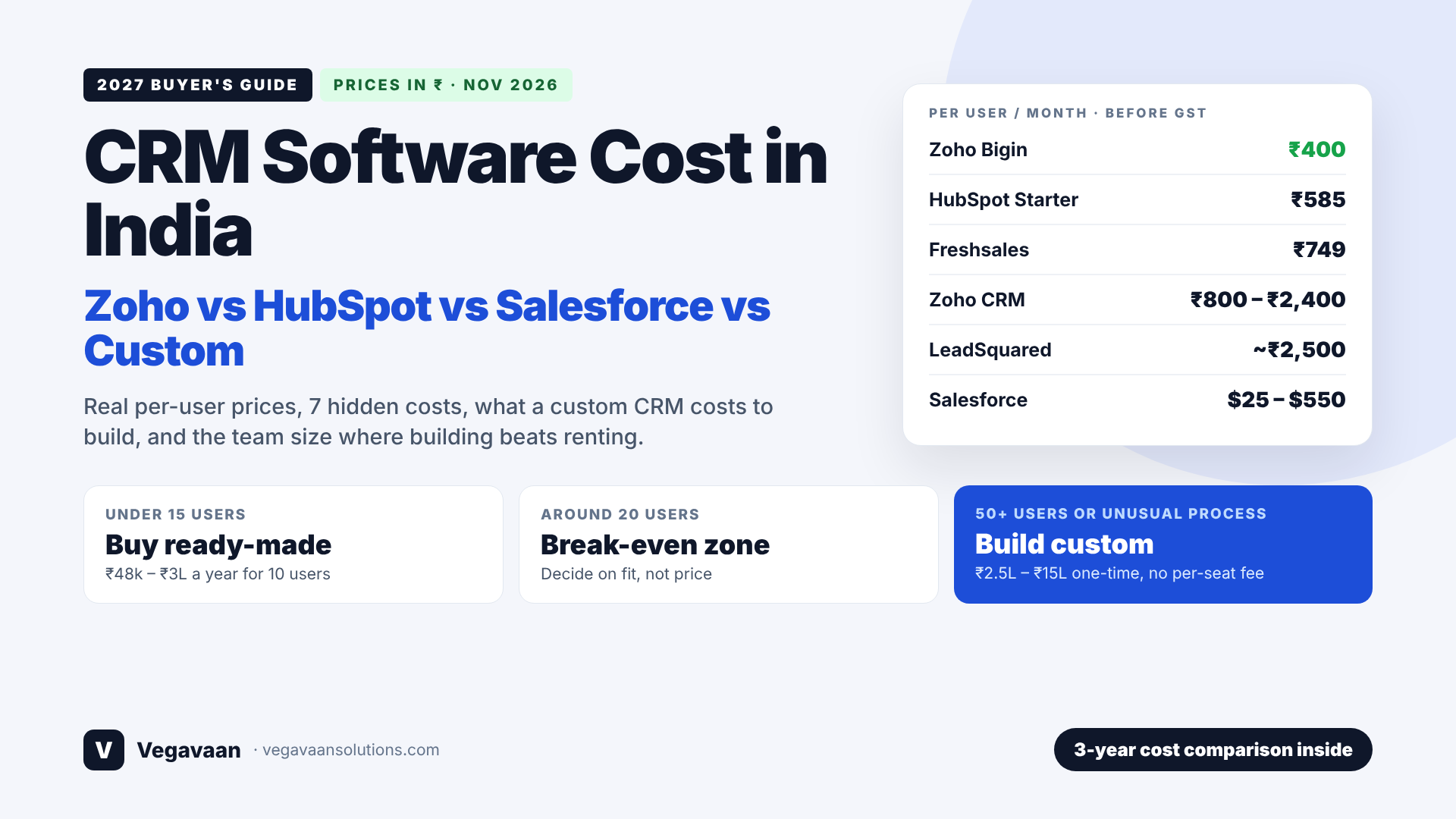
In India, ready-made CRM software costs about ₹400 to ₹2,500 per user per month for most small and mid-sized businesses (Zoho Bigin ₹400, HubSpot Starter ₹585, Freshsales ₹749, Zoho CRM ₹800 to ₹2,400, LeadSquared about ₹2,500), plus 18% GST. Enterprise tools such as Salesforce cost $25 to $550 per user per month. A custom CRM built for your business typically costs ₹2.5 lakh to ₹15 lakh one-time, plus 15 to 20% a year for maintenance. As a rule of thumb, ready-made CRM is cheaper for teams under about 15 to 20 users with standard sales processes; custom CRM becomes cheaper over three years for larger teams, unusual workflows or when you need deep integration with WhatsApp, Tally and your own systems.
CRM prices in India: plan-by-plan table
Published prices per user per month on annual billing, before 18% GST, as checked in October and November 2026. Prices change often; confirm on the vendor's site before buying.
| CRM | Plan | Price per user / month | Good for |
|---|---|---|---|
| Zoho Bigin | Express | ₹400 (₹550 monthly) | Very small teams moving off Excel |
| HubSpot Sales Hub | Starter | ₹585 new-customer price (list ₹1,670) | Marketing-led teams; check the renewal price |
| Freshsales | Growth | ₹749 (next tier ₹3,239) | Sales teams wanting built-in phone and email |
| TeleCRM | Core | ₹799 (quarterly ₹1,099) | Calling-heavy teams |
| Zoho CRM | Standard | ₹800 (₹1,300 monthly) | Most SMEs starting out |
| Professional | ₹1,400 | Growing teams needing automation and inventory | |
| Enterprise | ₹2,400 | Multi-team companies, advanced customisation | |
| LeadSquared | Sales Pro | About ₹2,500 | High-volume lead businesses: education, real estate, lending |
| Kylas | Elevate | ₹12,999 flat, unlimited users | Teams of 15+ wanting predictable cost |
| HubSpot Sales Hub | Professional | ₹7,497 + ₹1,25,000 one-time onboarding | Larger marketing and sales organisations |
| Salesforce | Starter / Pro Suite | $25 / $100 (billed in dollars) | Companies standardising on Salesforce |
| Sales Cloud Core / Advanced / Max | $195 / $395 / $550 | Enterprises with dedicated admins |
Zoho CRM is also free for up to three users, and Bigin has a free single-user tier, which is a sensible way to test before paying.
What it costs for 5, 10 and 20 users
Monthly cost on annual billing, before GST:
| CRM and plan | 5 users | 10 users | 20 users |
|---|---|---|---|
| Zoho Bigin Express | ₹2,000 | ₹4,000 | ₹8,000 |
| HubSpot Starter (intro price) | ₹2,925 | ₹5,850 | ₹11,700 |
| Freshsales Growth | ₹3,745 | ₹7,490 | ₹14,980 |
| Zoho CRM Standard | ₹4,000 | ₹8,000 | ₹16,000 |
| Zoho CRM Professional | ₹7,000 | ₹14,000 | ₹28,000 |
| Zoho CRM Enterprise | ₹12,000 | ₹24,000 | ₹48,000 |
| LeadSquared Sales Pro | ₹12,500 | ₹25,000 | ₹50,000 |
| Kylas Elevate (flat) | ₹12,999 | ₹12,999 | ₹12,999 |
So a 10-person sales team pays roughly ₹48,000 to ₹3 lakh a year in licences alone, depending on the tool and tier, before GST and before the hidden costs below.
7 hidden costs the price list does not show
- GST: add 18% to every price above. GST-registered businesses can usually claim input credit with a proper tax invoice.
- Dollar billing: Salesforce and some others bill in dollars, so your cost moves with the exchange rate, and imported services attract reverse-charge GST. From 1 January 2027, businesses under e-invoicing also need an IRN for those self-invoices. See our guide to the GST and e-invoicing changes.
- Onboarding and implementation: HubSpot Professional requires a ₹1,25,000 onboarding fee. For other tools, partners commonly charge for setup, data migration, custom fields and training.
- WhatsApp: most CRMs charge extra for WhatsApp integration, and Meta bills message charges separately. One popular tool adds ₹200 per user per month for chat sync plus a setup fee.
- Telephony: cloud calling, call recording and IVR are usually add-ons with per-minute or per-user charges.
- AI and add-ons: AI assistants are increasingly metered. Examples: ₹4,299 per 100 AI sessions on one tool, ₹756 per 1,000 AI credits on another.
- Intro pricing and tier jumps: a ₹585 seat can renew at ₹1,670, and the feature you need (workflow automation, custom modules, more records) often sits one tier up, at double the price.
Rule of thumb: budget 1.5 to 2 times the licence price for your real first-year cost.
What a custom CRM costs in India
A custom CRM is software built for your process, owned by you, with no per-user fee. Typical one-time costs from a small senior team, before GST:
| Scope | What you get | Typical cost | Timeline |
|---|---|---|---|
| Starter CRM | Leads, contacts, pipeline, follow-up reminders, basic reports, 2–3 roles, web only | ₹2.5 lakh – ₹5 lakh | 6–10 weeks |
| Growth CRM | Plus lead capture from website, IndiaMART and Justdial, WhatsApp integration, quotations, dashboards, mobile-friendly, 4–5 roles | ₹5 lakh – ₹9 lakh | 10–16 weeks |
| Advanced CRM | Plus Tally or ERP integration, field-sales mobile app, call logging, AI lead scoring and auto-replies, approvals, multi-branch | ₹9 lakh – ₹15 lakh+ | 16–26 weeks |
Running costs: hosting ₹3,000 to ₹15,000 a month depending on users, and maintenance of about 15 to 20% of the build cost a year. A multi-tenant CRM that you plan to sell to other businesses costs more, because billing, tenant isolation and onboarding have to be built too.
You can get a quick figure for your own case with our free software cost estimator (choose "Web app / portal").
Custom vs ready-made: 3-year cost comparison
Licence cost over three years versus a custom build with 20% yearly maintenance. All figures before GST; ready-made figures exclude the hidden costs above, so the real gap is smaller than it looks.
| Team size | Zoho CRM Standard (₹800) | Zoho CRM Professional (₹1,400) | Zoho CRM Enterprise (₹2,400) | Custom CRM (build + 3 years maintenance) |
|---|---|---|---|---|
| 5 users | ₹1.44 lakh | ₹2.52 lakh | ₹4.32 lakh | ₹4.8 lakh (₹3L build) |
| 10 users | ₹2.88 lakh | ₹5.04 lakh | ₹8.64 lakh | ₹8 lakh (₹5L build) |
| 20 users | ₹5.76 lakh | ₹10.08 lakh | ₹17.28 lakh | ₹9.6 lakh (₹6L build) |
| 50 users | ₹14.4 lakh | ₹25.2 lakh | ₹43.2 lakh | ₹14.4 lakh (₹9L build) |
What the table says:
- Under 10 users: ready-made wins clearly. Do not build.
- Around 20 users: custom is level with the mid tier and far below the top tier. Decide on fit, not price.
- 50 users and above: custom is usually cheaper than anything above the basic tier, and the gap widens every year because there is no per-seat fee.
Which one should you choose? A decision guide
| Choose a ready-made CRM if… | Choose a custom CRM if… |
|---|---|
| You have fewer than about 15 users | You have 20+ users, or expect to within two years |
| Your sales process is standard: lead → follow-up → quote → close | Your process is unusual: dealer networks, site visits, multi-step approvals, service plus sales |
| You need to start this month | You can invest 2–4 months for a system that fits exactly |
| You have no IT person and want the vendor to handle everything | You need deep integration with Tally, ERP, your app or your own product |
| You are still discovering how your sales process should work | Per-user fees stop you giving access to everyone who needs it (field staff, dealers, partners) |
| You are comfortable with your data on the vendor's cloud | You want to own the data and the code, and control where it is hosted |
A sensible middle path: start on a ready-made CRM for 6 to 12 months to learn what you really need, then build custom with those lessons. The worst outcome is building custom before you understand your own process. Our free requirement template helps you write that down.
12 features an Indian business CRM must have
- Automatic lead capture from website forms, IndiaMART, Justdial, TradeIndia, Facebook and Google ads
- WhatsApp integration: send and receive messages, templates and reminders from the lead record
- Call logging and click-to-call, ideally with recording
- Follow-up reminders that nobody can ignore, with missed follow-up reports
- Pipeline and stages you can rename to match your business
- Quotations and GST-compliant invoices or a link to your billing software
- Mobile access for field sales, with location check-in if needed
- Roles and permissions: salespeople see their leads, managers see the team
- Dashboards for source-wise leads, conversion rate and salesperson performance
- Tally or accounting integration so nobody types the same order twice
- Hindi or regional language support where your team needs it
- Data export and DPDP readiness: you can take your data out, delete on request and control access. See our DPDP checklist
How to roll out a CRM in 30 days
- Days 1–3: list your lead sources, sales stages, team roles and the five reports you want every Monday.
- Days 4–7: shortlist two tools (or one tool and one custom quote). Run the free trial with real leads, not demo data.
- Days 8–14: clean and import your existing leads and customers. Remove duplicates first.
- Days 15–20: connect lead sources, WhatsApp and calling. Set follow-up rules.
- Days 21–25: train the team in two short sessions. Make one person the CRM owner.
- Days 26–30: go live with one rule: "If it is not in the CRM, it did not happen." Review the first weekly report together.
6 mistakes that kill CRM projects
- Buying the top plan on day one. Start low; upgrade when a real need appears.
- No owner. A CRM without a named person responsible is abandoned in six weeks.
- Importing dirty data. Duplicates and old leads make the team distrust the system.
- Too many mandatory fields. Salespeople will fill three fields, not fifteen.
- The owner still asks for Excel reports. If the boss does not use the dashboard, nobody will.
- Building custom from a feature wish-list instead of the real daily process.
How Vegavaan can help
Vegavaan Info Solutions helps Indian businesses on both paths. If a ready-made CRM fits, we set it up properly: lead capture, WhatsApp and Tally integration, data migration and training. If you have outgrown per-user pricing or your process does not fit a template, we build a custom CRM with a small senior team: lead capture from all your sources, WhatsApp and call integration, quotations, dashboards, a field-sales app and AI features such as lead scoring and auto-drafted replies, with code and data in your name.
Get a free CRM recommendation Estimate a custom CRM
Tell us your team size, lead sources and current tools, and we will tell you honestly whether to buy or build.
Frequently asked questions
How much does CRM software cost in India?
Most ready-made CRMs cost ₹400 to ₹2,500 per user per month on annual billing, plus 18% GST. Examples: Zoho Bigin ₹400, HubSpot Starter ₹585, Freshsales ₹749, Zoho CRM ₹800 to ₹2,400 and LeadSquared about ₹2,500. Salesforce costs $25 to $550 per user per month.
What is the cheapest CRM for a small business in India?
Zoho CRM is free for up to three users and Zoho Bigin starts at ₹400 per user per month. For teams of 15 or more, a flat-fee tool such as Kylas at ₹12,999 a month for unlimited users can work out cheaper per person.
How much does it cost to build a custom CRM in India?
About ₹2.5 lakh to ₹5 lakh for a starter CRM, ₹5 lakh to ₹9 lakh with lead-source and WhatsApp integrations, and ₹9 lakh to ₹15 lakh or more with Tally or ERP integration, a field-sales app and AI features, plus 15 to 20% a year for maintenance.
Is a custom CRM better than Zoho or Salesforce?
Not for everyone. Ready-made tools are faster and cheaper for small teams with standard processes. Custom is better for larger teams, unusual workflows, deep integrations or when per-user fees limit who can use the system.
When does a custom CRM become cheaper than a subscription?
Over three years, a custom CRM is usually level with mid-tier subscriptions at around 20 users and clearly cheaper at 50 users or more, because there is no per-seat fee.
Can a CRM connect to WhatsApp, IndiaMART and Tally?
Yes. Most CRMs offer these through add-ons or partners at extra cost; a custom CRM can include them from the start. WhatsApp message charges from Meta are billed separately in both cases.
How long does it take to implement a CRM?
A ready-made CRM can go live in two to four weeks. A custom CRM takes about 6 to 26 weeks depending on scope.
Conclusion
There is no single "best CRM in India". There is the right one for your team size, your process and your three-year cost. Under 15 users with a standard process, buy a ready-made tool on a low plan and budget for the hidden costs. At 20 users and above, or when your process does not fit a template, compare a custom build on a three-year basis. Either way, name an owner, keep the fields few, and make the dashboard the only report.
Not sure which side of the line you are on? Talk to Vegavaan.
Sources: ViveLead: CRM pricing in India 2026 (prices checked 5 Nov 2026); LiftUp: CRM software price in India for 5, 10 and 20 users (Oct 2026). Vendor prices are from published price lists and change frequently; verify on each vendor's website.