
Updated: 15 November 2026
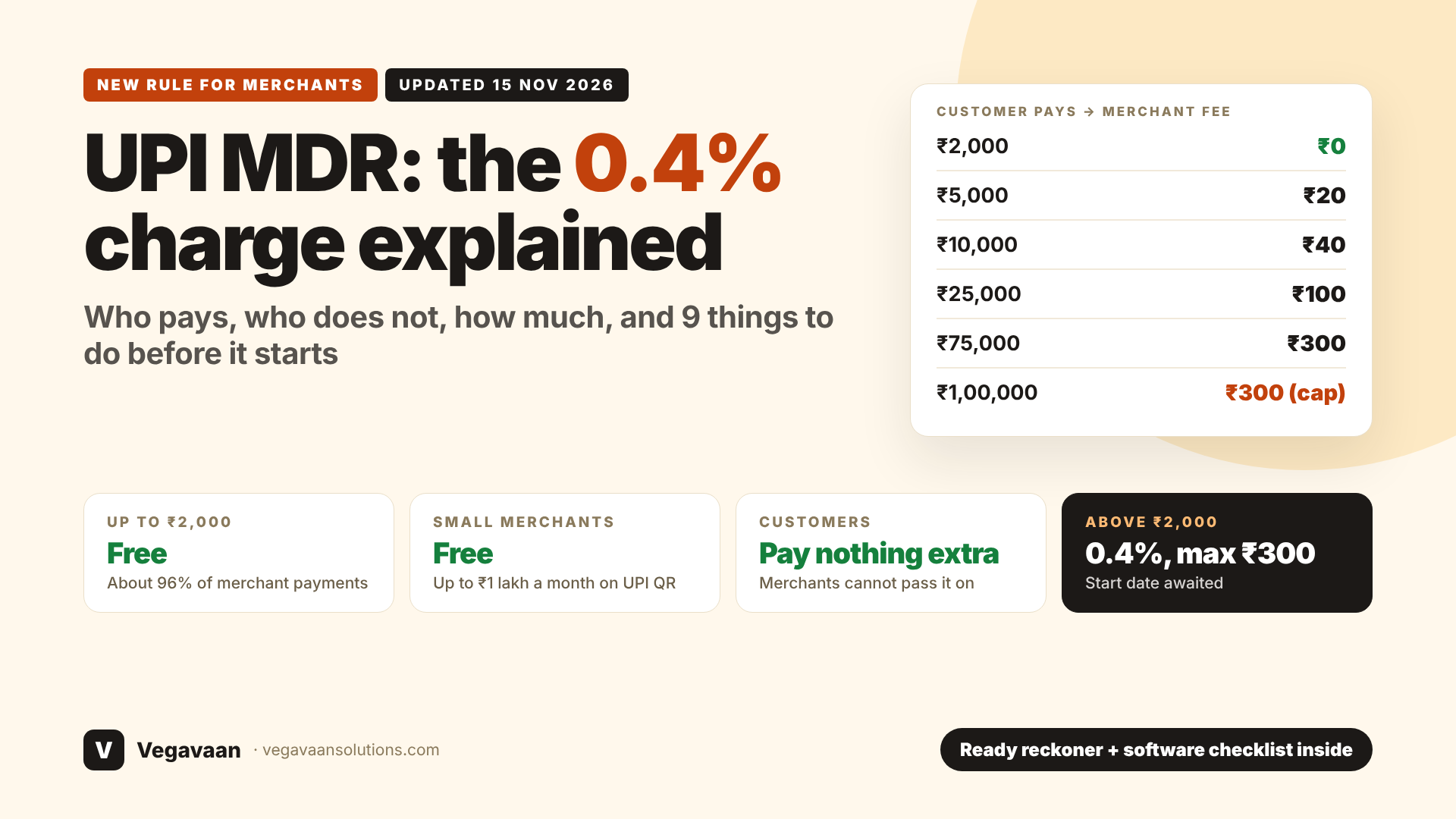
For ten years, accepting UPI cost an Indian business nothing. That is about to change. Under a framework notified in September 2026, merchants will pay a fee of 0.4% on UPI payments above ₹2,000, capped at ₹300 per payment. The start was first set for 15 October, then pushed to "after Diwali". Diwali is over, and the date can be announced any day.
The good news: most small shops will pay nothing, and customers cannot be charged at all. The less good news: if you sell anything with bills above ₹2,000 (electronics, furniture, jewellery, coaching fees, B2B supplies, clinic procedures), this is a new line in your costs, and your billing software, website checkout and accounts need to be ready for it.
This guide explains who pays, who does not, exactly how much, and the 9 things to do before the date is announced.
Contents
- Quick answer
- The rule at a glance
- Who pays and who does not
- How much per payment: ready reckoner
- What it costs per month: 6 business examples
- Can I charge the customer? No
- When does it start?
- 9 things to do before it starts
- What must change in your software and website
- 5 mistakes to avoid
- Frequently asked questions
Quick answer
UPI MDR is a fee of 0.4% that merchants will pay on customer-to-merchant UPI payments above ₹2,000, capped at ₹300 for payments of ₹75,000 and more. Payments up to ₹2,000, all person-to-person transfers, and small merchants receiving up to ₹1 lakh a month through UPI QR codes remain free. Customers pay nothing extra, and merchants are not allowed to pass the charge on. NPCI says the charge will affect only about 4% of merchant transactions. The start date, originally 15 October 2026, was deferred until after Diwali and had not been announced as of 15 November 2026. A challenge is also pending in the Supreme Court.
The rule at a glance
| Question | Answer |
|---|---|
| What is MDR? | Merchant Discount Rate: a fee the merchant pays for accepting a digital payment. It is deducted before the money is settled to you |
| Rate | 0.4% of the payment amount |
| Applies to | Person-to-merchant (P2M) UPI payments above ₹2,000 |
| Cap | ₹300 per payment (reached at ₹75,000) |
| Who pays | The merchant, never the customer |
| Special rates | Flat ₹5 above ₹2,000 for sectors such as railways, telecom, insurance, fuel and agricultural inputs; 0.02% (max ₹300) for mutual funds and stockbrokers |
| Notified by | Central government notification, 14 September 2026; NPCI circular and FAQs, 15 September 2026 |
| Start date | Not yet announced (see below) |
Who pays and who does not
| Situation | MDR? |
|---|---|
| Customer pays you ₹2,000 or less by UPI | No |
| Friends or family send money to each other (P2P) | No, at any amount |
| Small merchant receiving up to ₹1 lakh a month through UPI QR (the "P2PM" category) | No |
| Payment by RuPay debit card | No |
| UPI AutoPay mandates | No |
| Customer pays a merchant more than ₹2,000 by UPI | Yes, 0.4% up to ₹300 |
One detail small shops should know: if your UPI receipts stay above ₹1 lakh a month for three months in a row, you move out of the small-merchant category. Ask your bank or payment app which category you are in today.
NPCI says about 96% of merchant UPI payments are ₹2,000 or less. So a tea stall, a kirana store or a small clinic with ₹300 to ₹500 consultation fees will see little or no change.
How much per payment: ready reckoner
The fee is calculated on the full amount once a payment crosses ₹2,000.
| Customer pays | MDR (0.4%) | You receive |
|---|---|---|
| ₹2,000 | ₹0 | ₹2,000 |
| ₹3,000 | ₹12 | ₹2,988 |
| ₹5,000 | ₹20 | ₹4,980 |
| ₹10,000 | ₹40 | ₹9,960 |
| ₹25,000 | ₹100 | ₹24,900 |
| ₹50,000 | ₹200 | ₹49,800 |
| ₹75,000 | ₹300 | ₹74,700 |
| ₹1,00,000 | ₹300 (cap) | ₹99,700 |
Whether GST applies on top of this fee has not been clearly stated in the sources we could check. Ask your bank or payment provider to confirm in writing.
What it costs per month: 6 business examples
These are illustrations to show the method, not real businesses. Use your own numbers.
| Business | UPI payments above ₹2,000 in a month | Approx. MDR per month |
|---|---|---|
| Kirana store, ₹80,000 a month on UPI QR | Small-merchant category | ₹0 |
| Clinic, 300 payments of ₹500 | None | ₹0 |
| Garment shop | ₹2,50,000 in bills above ₹2,000 | ₹1,000 |
| Coaching institute | 100 fee payments of ₹25,000 | ₹10,000 |
| Electronics shop | ₹20,00,000, average bill ₹15,000 | ₹8,000 |
| B2B wholesaler | 40 payments of ₹1,00,000 | ₹12,000 (₹300 each, due to the cap) |
What this shows: the cap matters. On a ₹1,00,000 payment the effective rate is 0.3%, and it keeps falling as the amount rises. Mid-sized bills between ₹2,000 and ₹75,000 feel the full 0.4%.
Can I charge the customer? No
NPCI has told the Supreme Court that merchants and UPI apps "cannot pass this charge on to consumers", and the Ministry of Finance has said it "is not a charge on customers making UPI payments". UPI apps are also barred from adding platform fees for it.
In practice, that means:
- No "UPI charge" or "convenience fee" line on the bill for UPI payments
- No higher price for UPI than for cash at the counter
- No extra fee on your website or app checkout when the customer chooses UPI
NPCI has said violations can lead to compliance action. If the cost matters to your margins, the place to handle it is your overall pricing, not a surcharge.
When does it start?
| Date | What happened |
|---|---|
| 14 September 2026 | Central government notification |
| 15 September 2026 | NPCI circular and FAQs; start date given as 15 October |
| 13 October 2026 | NPCI says MDR will be implemented "immediately post Diwali at a date to be notified separately" |
| 3 November 2026 | NPCI files its reply in the Supreme Court in a case challenging the charge; no new date given |
| 11 November 2026 | NPCI circular on an MDR-funded scheme for small merchants, to run for three years from the MDR start |
| 15 November 2026 | Start date still not announced, as far as we could find |
Because a court case is pending, the details could still change. Prepare now, but confirm the final date and rate with your bank.
9 things to do before it starts
- Find out your category. Ask your bank or payment app whether you are registered as a small merchant (P2PM) or a regular merchant (P2M).
- Download three months of UPI statements. Count how many payments were above ₹2,000 and their total value.
- Estimate your monthly cost. Total value of payments between ₹2,001 and ₹75,000 × 0.4%, plus ₹300 for each payment above ₹75,000.
- Ask your bank or payment provider four questions: the exact rate for your business type, whether GST is added, how the fee will show in settlement reports, and whether they charge anything of their own on top.
- Add an expense head such as "UPI MDR charges" in your accounts, and tell your accountant.
- Plan for reconciliation. A ₹10,000 sale will arrive as ₹9,960. Your invoice must still say ₹10,000. Decide how the ₹40 difference will be recorded.
- Check your website and app checkout for any fee or price difference on UPI, and remove it.
- Brief your staff: accept UPI as before, do not ask customers for extra, and do not refuse UPI for larger bills.
- Review pricing calmly. For most businesses the cost is small. If your margins are thin and your bills are large, build it into prices at your next revision.
What must change in your software and website
This is the part most businesses will discover late. MDR is deducted before settlement, so every system that matches "what was billed" to "what reached the bank" needs attention.
| System | What to check or change |
|---|---|
| Billing / POS software | Payment-mode reports should show gross amount, MDR and net settlement separately |
| Accounting (Tally, Zoho Books, custom ERP) | New ledger for MDR; automatic entry for the difference instead of manual journal entries |
| Bank reconciliation | Matching rules must accept a net credit against a gross invoice, or every UPI sale above ₹2,000 will show as "short received" |
| Website / app checkout | No surcharge on UPI; order total equals amount charged; refunds return the full amount |
| Payment gateway integration | Read the settlement file format; capture the fee field in your database |
| Dashboards and MIS | Add "payment cost" by mode, so you can compare UPI, cards and bank transfer |
| Fee collection (schools, coaching, societies) | Receipts must show the full fee paid; the institution absorbs the MDR |
If you are also preparing for the e-invoicing changes from January 2027, do both together. Our GST and e-invoicing checklist covers that side.
5 mistakes to avoid
- Adding a UPI surcharge. It is not permitted and customers will notice.
- Refusing UPI above ₹2,000. You will lose sales to save 0.4%.
- Splitting one bill into several payments under ₹2,000. It creates an accounting mess, annoys customers and looks like an attempt to dodge the rule.
- Asking customers to pay to a personal UPI ID. Mixing business income into personal accounts creates tax and GST problems far bigger than 0.4%.
- Ignoring it because "it is small". The money is small; the reconciliation errors in unprepared software are not.
How Vegavaan can help
Vegavaan Info Solutions helps businesses get their systems ready for changes like this. We review how payments flow through your billing software, website, app and accounts; update checkout and payment gateway integrations; set up automatic MDR entries and reconciliation; and add a simple dashboard that shows what each payment mode really costs you. If you run custom software or an ERP, we make the change once so your team does not correct entries by hand every day.
Get your payment systems checked
Tell us which billing software, payment gateway and accounting tool you use, and we will tell you what needs to change.
Frequently asked questions
What is the new UPI charge for merchants?
A Merchant Discount Rate of 0.4% on customer-to-merchant UPI payments above ₹2,000, capped at ₹300 per payment.
Will customers have to pay for UPI?
No. The charge is on merchants only. Person-to-person transfers stay free, and merchants and apps are not allowed to pass the fee to customers.
Do small shopkeepers have to pay UPI MDR?
Small merchants receiving up to ₹1 lakh a month through UPI QR codes are exempt, and no merchant pays on payments of ₹2,000 or less.
How much is the charge on ₹10,000 and ₹1 lakh?
₹40 on ₹10,000. On ₹1,00,000 it is ₹300 because of the cap.
From which date will UPI MDR apply?
It was originally due on 15 October 2026 and was deferred until after Diwali. As of 15 November 2026 the new date had not been announced. Check with your bank.
Is UPI still cheaper than cards?
NPCI says its 0.4% ceiling is significantly lower than charges on card payments. RuPay debit card payments carry no MDR.
Is there GST on UPI MDR?
We could not find a clear official statement. Ask your bank or payment provider to confirm how the fee will be invoiced.
Do I need to change my billing software?
If you take UPI payments above ₹2,000, yes: your reports and reconciliation need to handle a net settlement against a gross bill, and your accounts need an MDR expense entry.
Is the charge final?
The framework is notified, but a petition challenging it is pending in the Supreme Court and the start date is not yet announced, so details may change.
Conclusion
UPI is not becoming expensive. For most small businesses it stays free, and for the rest it costs ₹4 on every ₹1,000 above the threshold, with a ₹300 ceiling. The real risk is not the fee; it is being unprepared, with a checkout that overcharges, staff who ask customers for extra, and accounts that do not match the bank. Spend an hour this week on the nine steps above, and the start date will be a non-event.
Need help getting your systems ready? Talk to Vegavaan.
This article is general information, not legal or tax advice. Rates and dates are as reported on 15 November 2026 and may change. Sources: MediaNama: NPCI tells Supreme Court merchants cannot pass UPI charges on to customers; Inc42: NPCI unveils MDR-funded scheme for small merchants; NPCI FAQs on MDR (15 September 2026) and Ministry of Finance release (15 September 2026), as reported.