
Updated: 7 November 2026
On 5 November 2026, the company behind USA Today, one of the largest news brands in the world, reported a 7.4% fall in quarterly revenue and told investors why: readers now get AI-generated summaries from Google and other platforms and do not click through. Its CEO said the change in search behaviour had an "outsized impact" on the business. The company has cut $100 million in costs and laid off staff.
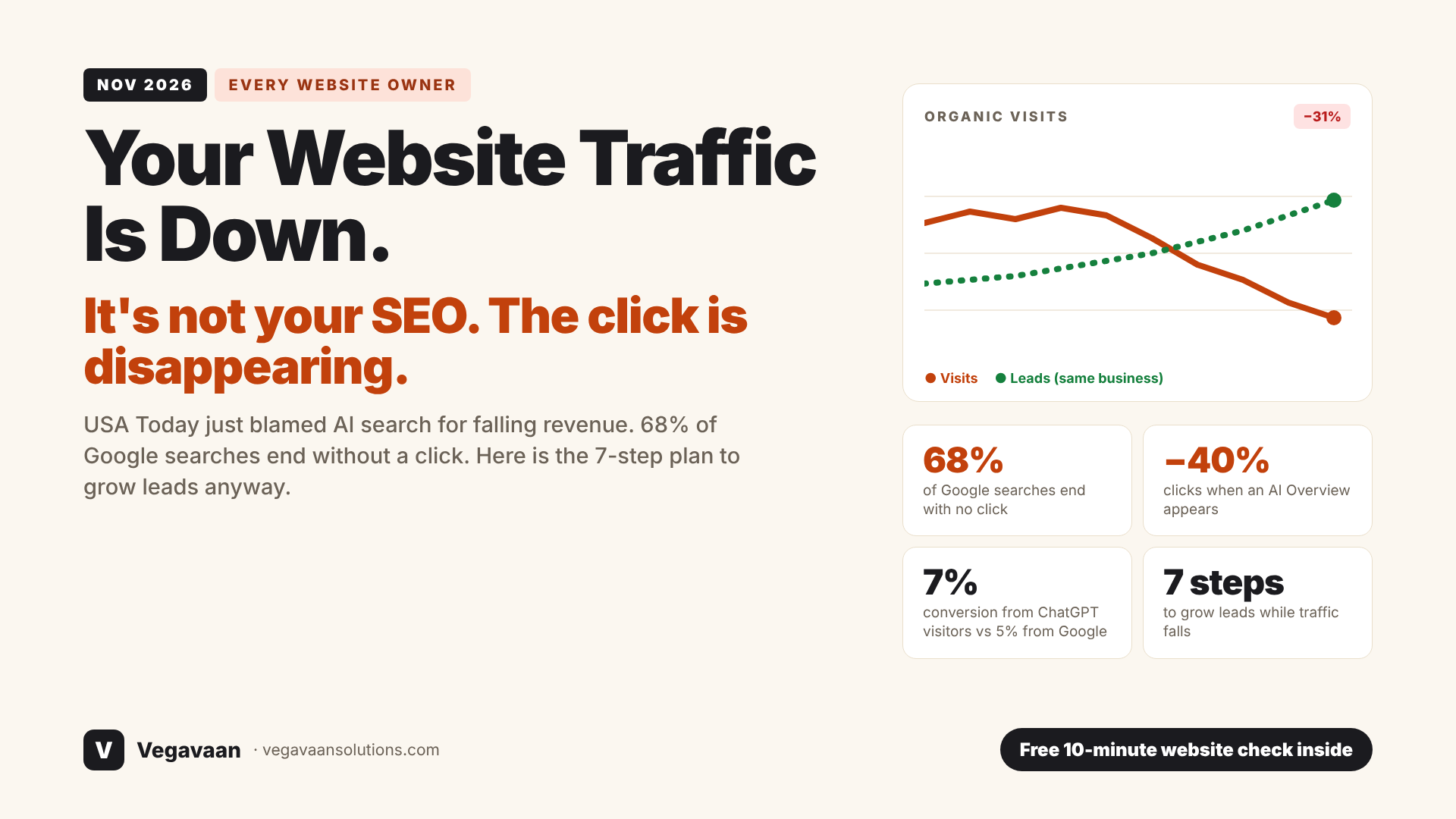
If a newsroom with thousands of journalists cannot hold its Google traffic, the small business owner in Faridabad looking at a falling Analytics graph should hear one thing clearly: it is not your SEO. The click itself is disappearing.
This article explains what is happening with real numbers, why most businesses are measuring the wrong thing, and a 7-step plan to grow leads while website traffic falls. It is the plan we now use for our own site and our clients'.
Contents
- Quick answer
- The numbers: what happened to clicks
- Why your traffic graph is falling
- Stop measuring visits. Measure this instead
- The 7-step plan to grow leads while traffic falls
- What this looks like for an Indian SME
- A 10-minute check for your own website
- Frequently asked questions
Quick answer
Website traffic is falling across the internet because about 68% of Google searches now end without a click, and a controlled field experiment found that Google's AI Overviews cut clicks to websites by about 40% on the searches where they appear. Even USA Today's parent company blamed AI search for its revenue decline this week. For a business, the right response is not more blog posts for traffic: it is to measure leads instead of visits, make your business visible inside AI answers and Google's own surfaces, give people a reason to click (tools, prices, bookings), build channels you own (WhatsApp list, email, Google Business Profile) and make your site something AI agents can act on, not just read.
The numbers: what happened to clicks
| Finding | Number | Source |
|---|---|---|
| Google searches that end with no click | About 68% (closer to 80% on desktop) | Similarweb clickstream panel, 2026 |
| Rise in zero-click rate over ten years | From about 45% (2016) to 68% (2026), steepest in the last two years | Similarweb |
| Effect of an AI Overview on clicks to websites | Outbound organic clicks fall 39.8%; zero-click searches rise 34.5% | Field experiment, 1,065 users, 68,089 searches, Indian School of Business and Carnegie Mellon, 2026 |
| How often AI Overviews appear | On about 41% of queries in the experiment; over 20% of searches overall | Same study; Similarweb |
| Which searches are hit hardest | Informational queries (71% of all searches). Transactional and navigational queries show no measurable loss | Same study |
| Referrals from Google's AI Mode | 1.6–2.5% of queries send a click, versus 17–19% for classic search | Similarweb, Jan–Apr 2026 |
| Visitors who do arrive from ChatGPT | Spend 15 minutes vs 8 from Google; convert at 7% vs 5% on transactional sites | Similarweb, US desktop |
| USA Today Co., Q3 2026 | Revenue down 7.4% to $519.2 million; CEO blames changed search behaviour; $100 million in cuts | Earnings call, 5 Nov 2026 |
Two details in that table matter more than the headline. First, the loss is concentrated in "how to" and "what is" searches. Searches with buying intent ("website developer in Faridabad", "book dentist near me") still send clicks. Second, the few visitors who come from AI tools are better visitors: they stay longer and buy more.
Why your traffic graph is falling
- Google answers the question itself. The AI Overview sits in the top position on 87% of the searches where it appears, and that is exactly where your best ranking used to earn its clicks.
- People ask ChatGPT first. India is now ChatGPT's largest market, with usage doubling since January. Many of those questions never reach Google at all. See our piece on India becoming ChatGPT's #1 market.
- Google keeps more journeys inside Google. Business Profiles, Maps, Shopping, "People also ask" and AI Mode all answer without sending anyone to a website.
- Your blog posts were built for the old game. Informational articles written to rank are the content type AI summarises most easily, and credits least.
None of this means SEO is dead. Being indexed, fast, structured and trusted is now the price of being quoted. What died is the assumption that ranking equals visits.
Stop measuring visits. Measure this instead
| Old metric | New metric | How to track it |
|---|---|---|
| Sessions and page views | Leads per week (calls, WhatsApp messages, forms, bookings) | Click-to-call and WhatsApp buttons with tracking; a simple lead sheet |
| Keyword rankings | Branded searches (people searching your name) | Search Console: queries containing your brand |
| Organic traffic | AI share of voice: are you named when someone asks ChatGPT, Gemini or Perplexity for your service in your city? | Ask the five questions monthly; keep a scorecard |
| Bounce rate | Impressions without clicks (you were shown, even if not clicked) | Search Console impressions vs clicks |
| Blog views | Owned audience growth: WhatsApp broadcast list, email list, Google Business Profile followers | Count subscribers monthly |
When we moved clients to this scorecard, a common pattern appeared: traffic down 20–30%, leads flat or up. The business was fine; the dashboard was lying.
The 7-step plan to grow leads while traffic falls
- Be the answer, not the link. Write pages that state the conclusion in the first two sentences, use clear headings, include sourced statistics and direct quotes, and answer one question per section. Research on generative engines found that adding quotations and statistics raised citation rates by roughly 30–40%. This is the content AI tools quote and name.
- Win the searches that still click. Put your effort into transactional and local pages: "[service] in [city]", pricing pages, comparison pages, booking pages. Those are the queries where the field experiment found no click loss. Our guide to ranking on Google Maps covers the local side.
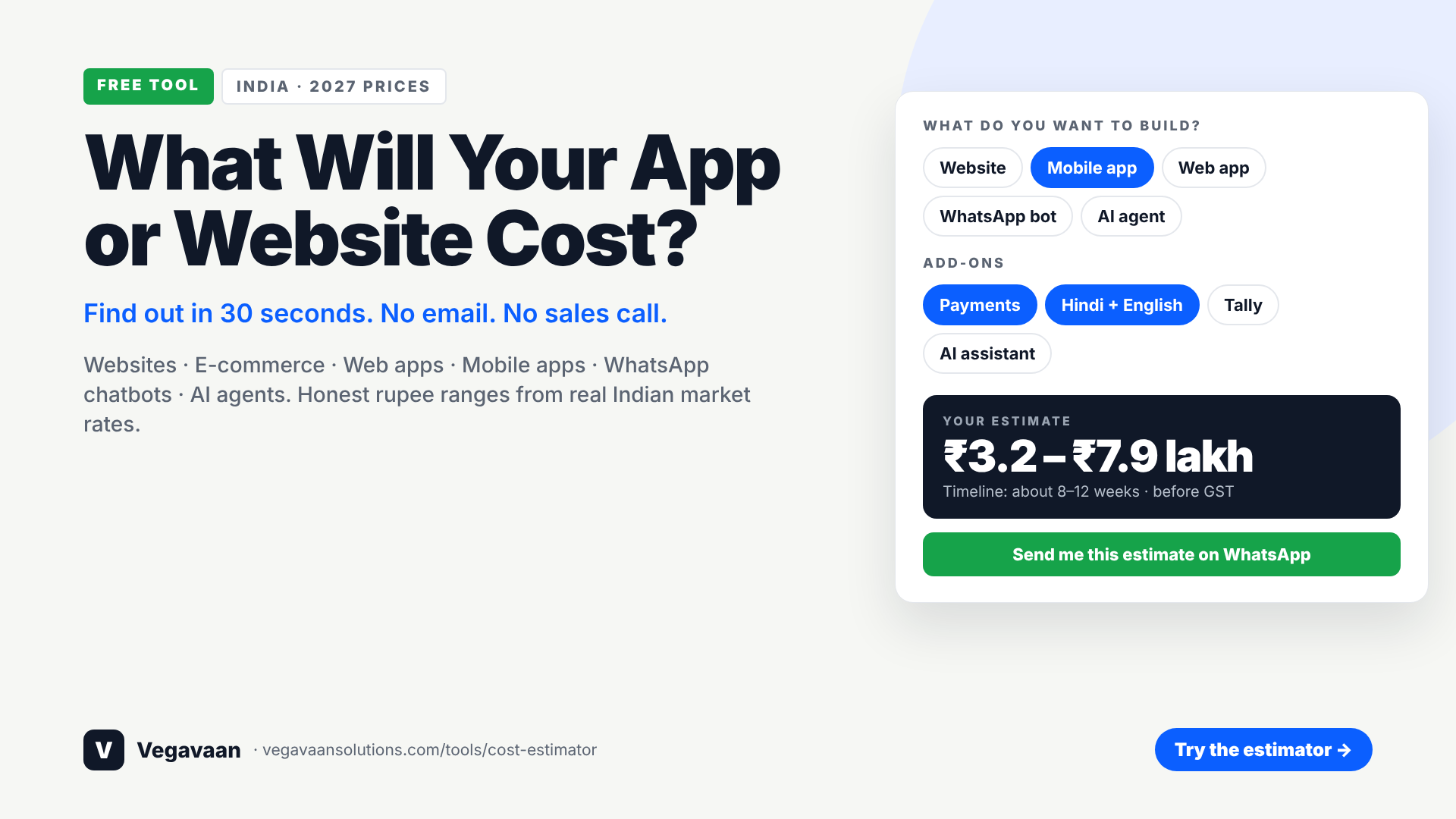
- Give people a reason to click that an AI cannot replace. Calculators, estimators, checklists they can download, live prices, availability, a booking slot. We built a free software cost estimator for exactly this reason: an AI can summarise an article, it cannot run your tool.
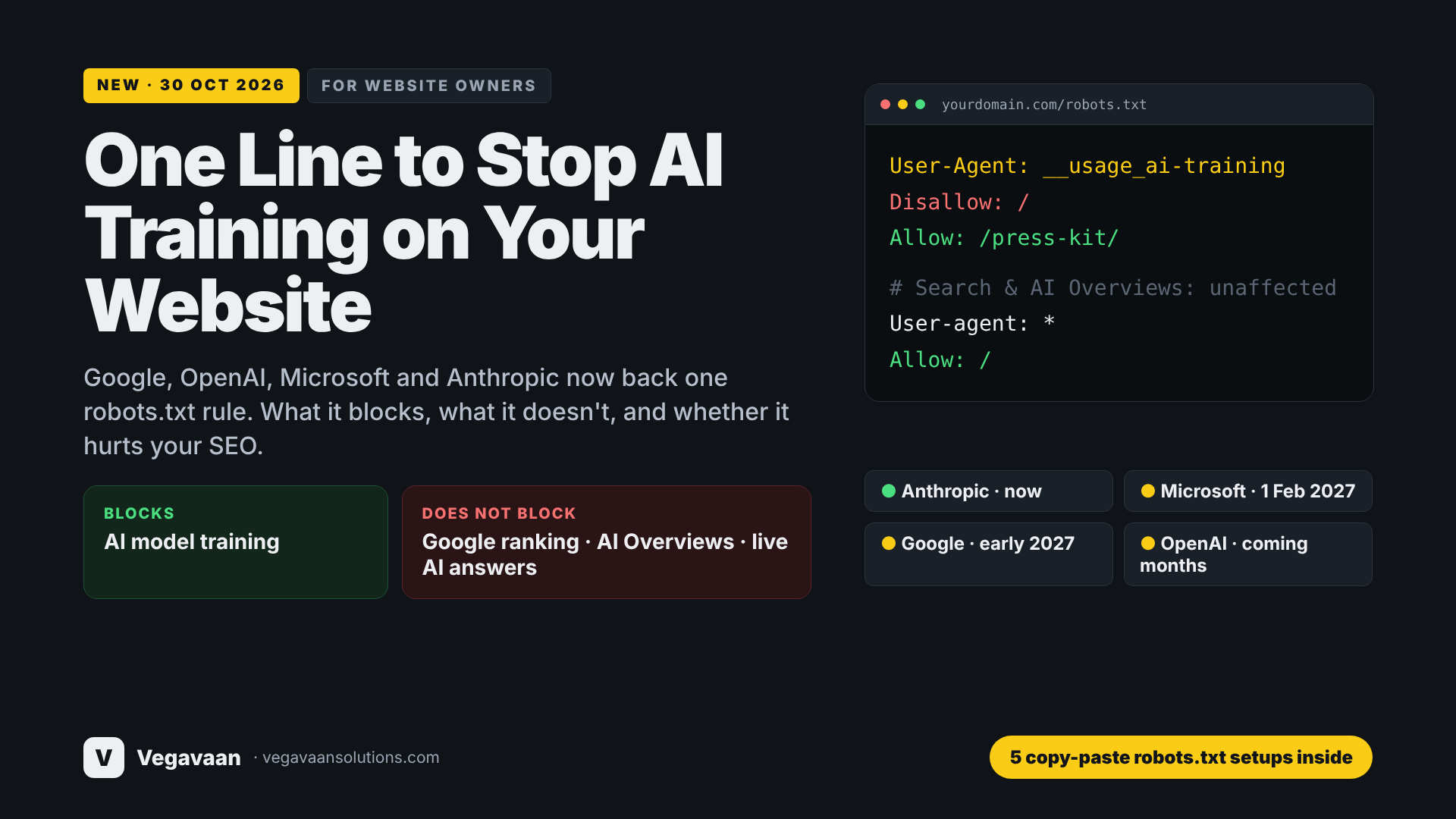
- Fix your facts everywhere AI looks. Same name, address, phone, services and prices on your website, Google Business Profile, directories and LinkedIn. Structured data (Organisation, LocalBusiness, FAQ, Product) on your pages. Keep AI crawlers allowed in robots.txt; see our guide to the new AI training rule in robots.txt.
- Build channels you own. A WhatsApp broadcast list, an email list, Google Business Profile posts, a LinkedIn page. Every visitor who does arrive should be invited to one of them. Traffic you rent from Google can vanish; a list cannot be taken away.
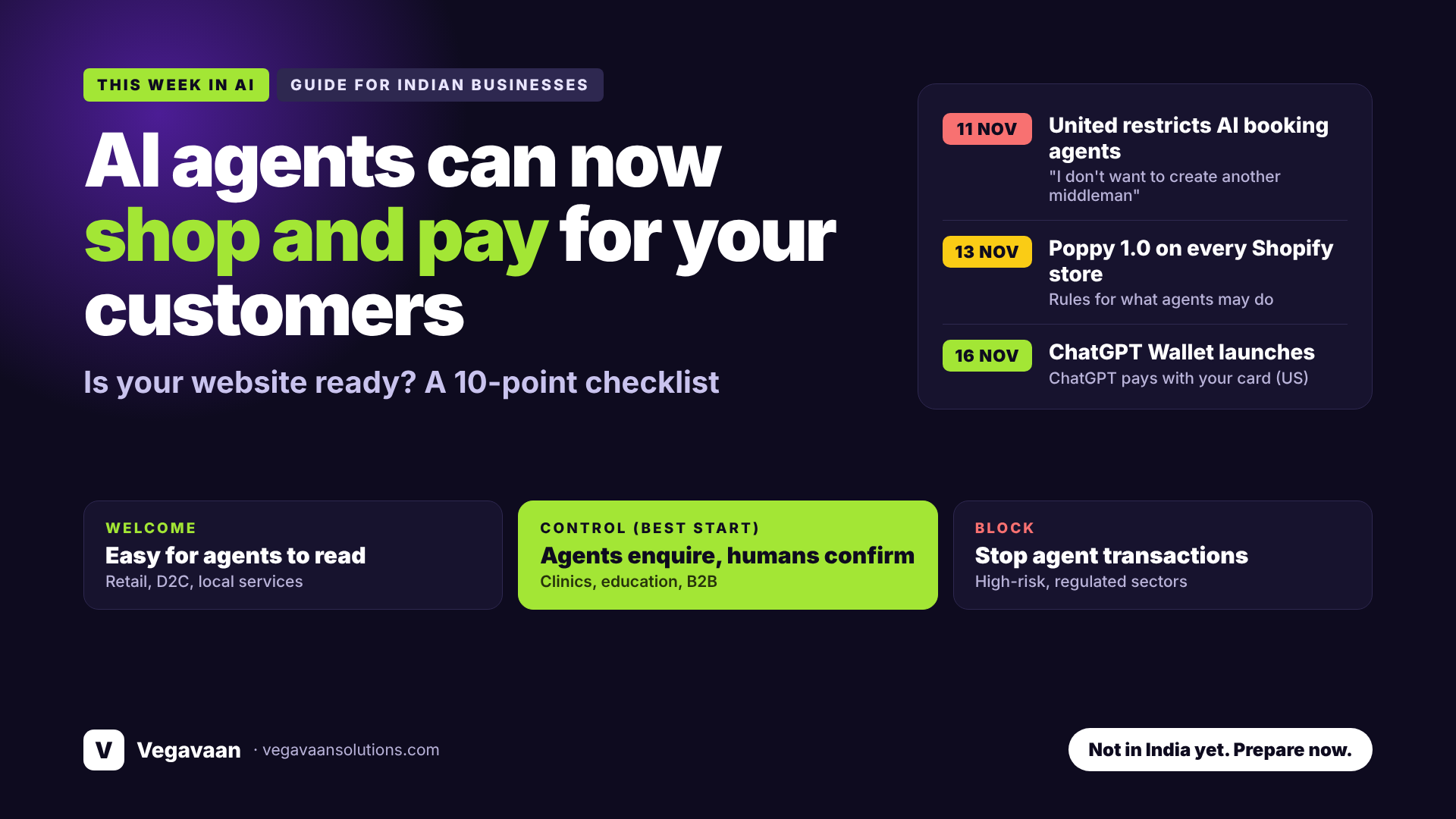
- Make your site something an AI agent can act on. AI assistants are starting to book, order and enquire on behalf of users. Clear pricing, a working booking or enquiry flow, schema markup and no login walls for basic information make you "executable", not just readable.
- Turn the few visitors into more leads. Fewer visits means every one matters: WhatsApp button on every page, a phone number that is answered, a form with three fields not twelve, and a reply within five minutes. A WhatsApp AI chatbot does this at any hour.
What this looks like for an Indian SME
| Business | Stop doing | Start doing |
|---|---|---|
| Clinic | Generic "10 tips for healthy living" blogs | Complete Google Business Profile, appointment booking on the site, WhatsApp follow-ups, factual service pages with fees |
| Manufacturer or distributor | Chasing "what is [product]" keywords | Product pages with specifications and price ranges, a dealer enquiry form, a quotation calculator, IndiaMART and Justdial consistency |
| CA, lawyer, consultant | Long explainers that AI summarises | Service and pricing pages, a free checklist tool, a WhatsApp enquiry line, LinkedIn posts that build branded search |
| Retailer or D2C brand | Fighting for informational traffic | Product data that AI shopping answers can read, reviews, availability, fast checkout, a broadcast list for offers |
| Software or agency | Traffic-bait listicles | Interactive tools, transparent pricing, case pages with numbers, strong LinkedIn presence for branded search |
A 10-minute check for your own website
- ☐ Open Search Console. Are impressions steady while clicks fall? That is the zero-click effect, not a penalty.
- ☐ Which of your top 10 pages are informational and which are transactional? Protect and improve the transactional ones.
- ☐ Ask ChatGPT and Gemini: "best [your service] in [your city]" and "tell me about [your business]". Are you named correctly?
- ☐ Is there a WhatsApp or call button visible on every page on mobile?
- ☐ Do you have at least one page an AI cannot replace: a tool, a calculator, live prices, a booking flow?
- ☐ Do you own any audience at all (WhatsApp list, email list) or is Google your only source?
- ☐ Is your robots.txt blocking AI crawlers by accident?
How Vegavaan can help
Vegavaan Info Solutions helps Indian businesses move from "traffic" to "leads": transactional and local pages that still earn clicks, structured data and consistent listings so AI assistants name you correctly, interactive tools that give people a reason to visit, WhatsApp automation that converts the visitors you do get, and a monthly scorecard built on leads and AI visibility rather than sessions.
👉 Ask for a free AI-visibility and lead audit: we run the 10-minute check on your site and send you the results.
Frequently asked questions
Why is my website traffic dropping in 2026?
Mainly because about 68% of Google searches now end without a click, AI Overviews reduce clicks to websites by about 40% where they appear, and many people ask ChatGPT or Gemini instead of Google. Informational pages are hit hardest; transactional and local searches still send clicks.
Is SEO still worth it?
Yes, but the goal has changed. Being indexed, fast, structured and trusted is what gets you quoted in AI answers and shown in Google's own surfaces. Measure leads, branded searches and AI mentions rather than visits.
What are zero-click searches?
Searches where the user gets what they need on the results page, from an AI Overview, a map, a knowledge panel or a snippet, and never clicks a website. Similarweb puts the rate at about 68% in 2026.
How do I get my business mentioned in ChatGPT or Google AI answers?
Keep your facts consistent everywhere, publish specific pages with prices, locations and FAQs, add structured data, earn mentions and reviews on trusted sites, keep AI crawlers allowed, and test monthly by asking the assistants about your business.
Should I stop writing blog posts?
Stop writing generic informational posts for traffic. Keep writing content that answers specific buyer questions, includes original data or tools, and builds your brand on LinkedIn and in AI answers.
What should a small business track instead of traffic?
Leads per week (calls, WhatsApp, forms, bookings), branded search volume, AI share of voice, Search Console impressions, and growth of owned audiences such as WhatsApp and email lists.
Conclusion
The click economy that built the web for twenty years is shrinking, and the largest publishers are the first to say so out loud. For a business, that is not a crisis; it is a change of scoreboard. Be the answer AI quotes, win the searches that still click, give people a reason to visit that no summary can replace, own your audience, and count leads instead of visits. Do that, and a falling traffic graph stops being frightening.
Want the 10-minute check done for you? Talk to Vegavaan.
Sources: Poynter: USA Today Co. blames AI for its revenue woes (Nov 2026); PPC Land: Field experiment finds AI Overviews cut publisher clicks 39.8% (Agarwal and Sen, ISB and Carnegie Mellon, 2026); Similarweb: Zero-click marketing, 2026 data; The Neuron: AI news, 6 Nov 2026.