
Updated: 30 October 2026
On 28 October 2026, GitHub published its annual Octoverse report, and one line in it should stop every Indian developer, IT company and business owner for a moment:
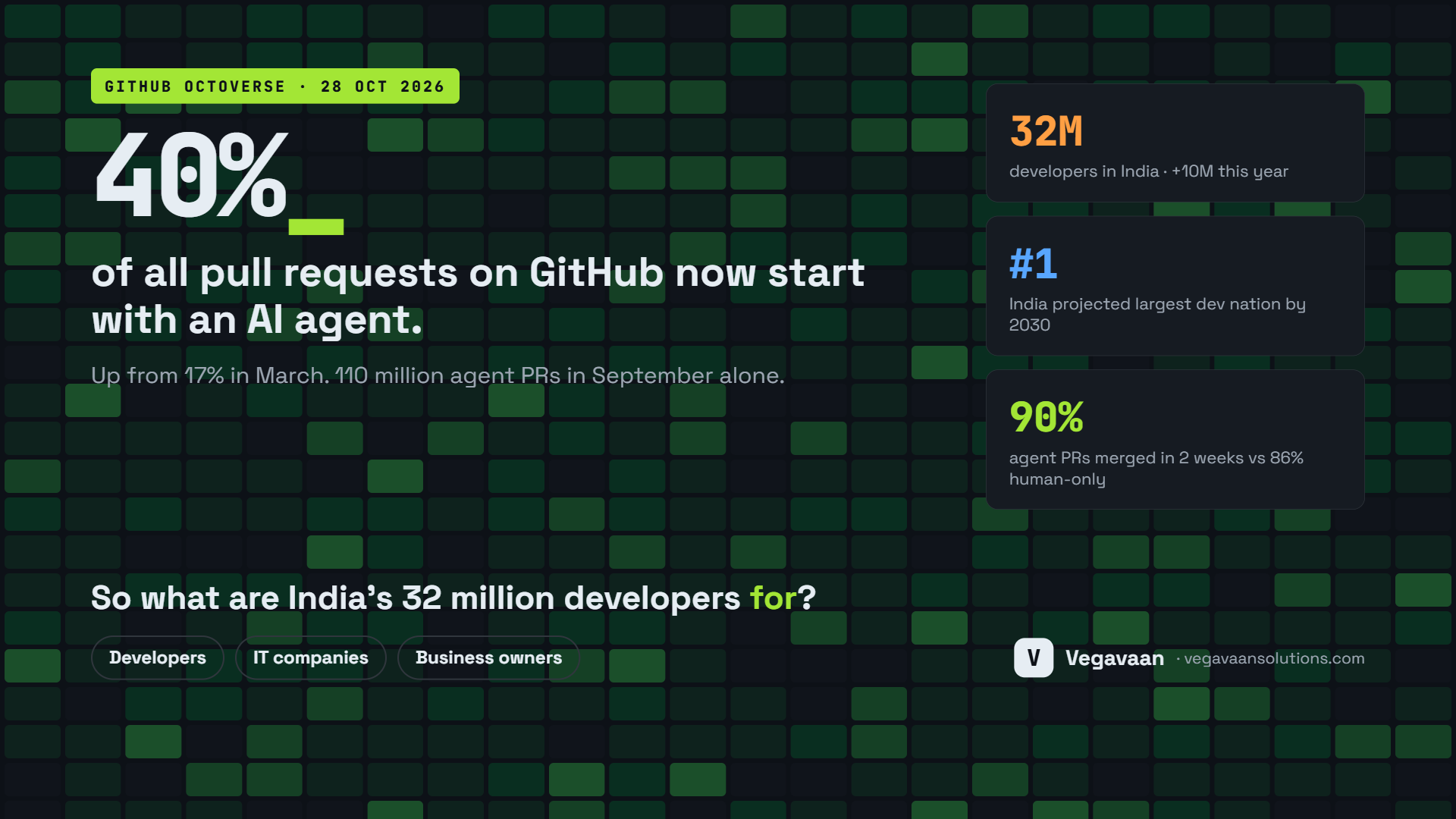
"As of September, developers start more than 40% of pull requests with an agent."
In March 2026 that number was 17%. In September alone, AI agents started 110 million pull requests, about six times March's volume. And the code is not being thrown away: agent-involved pull requests are now merged faster than human-only ones.
The same report says India now has 32 million developers on GitHub, added more than 10 million in a single year, and is projected to overtake the United States as the world's largest developer community by 2030.
Put those two facts together and you get the most important question in Indian tech right now: if AI starts nearly half the code, what are 32 million Indian developers for? This article answers it with data, not hype, for three readers: developers, IT companies, and business owners who pay for software.
Contents
- Quick answer
- The data: what Octoverse 2026 actually says
- India's 32 million developers
- What "40% by agents" really means (and does not mean)
- Who is paying for all this AI
- For developers: the 5 shifts
- For IT companies: the new unit economics
- For business owners: software just changed price
- How we work at Vegavaan
- Frequently asked questions
Quick answer
GitHub's Octoverse 2026 report (28 October 2026) found that AI agents start more than 40% of pull requests, up from 17% in March, and that agent-involved pull requests are merged within two weeks 90% of the time versus about 86% for human-only ones. India has 32 million GitHub developers and is projected to become the largest developer country by 2030. This does not mean developers are being replaced: it means the job is shifting from typing code to specifying, reviewing, testing and securing it. Developers who can direct and check AI will be in more demand; those who only type what they are told will be in less. For businesses, routine software is getting cheaper and faster, while judgement, architecture and security are becoming the expensive part.
The data: what Octoverse 2026 actually says
| Metric | Figure |
|---|---|
| Pull requests started by an agent (Sept 2026) | More than 40%, up from 17% in March |
| Agent-started pull requests in September alone | 110 million, about 6× March |
| Merged within two weeks: agent-involved PRs | 90% (up from 83% in February) |
| Merged within two weeks: non-agent PRs | About 86%, unchanged |
| Agent PRs touching multiple files | 87% vs 79% for non-agent PRs |
| Share of merged PRs with detected AI involvement, by language | TypeScript 44%, Python 41%, Rust 40%, Java 21% |
| Repos with an agent configuration file | 8× as many commits as new repos without one |
| Total pushes, 12 months | 17.9 billion, more than 2024 and 2025 combined |
| Merged pull requests, 12 months | 1.3 billion, about 3.5 million a day |
| Copilot users on agentic features | 55%, up from 35% |
| AI-assisted code review usage | Up more than 90% year on year |
| Secret-scanning push protection scans | 5.8 billion, nearly 4× 2025 |
Three things stand out. Volume exploded (more code pushed in one year than the previous two combined). Agents are doing bigger changes, not just one-line fixes. And review and security tooling grew almost as fast as generation, which tells you where the human work moved.
India's 32 million developers
| Country | Developers on GitHub (2026) | Projected 2030 |
|---|---|---|
| United States | 38.3 million (+10 million this year) | 54.7 million |
| India | 32.0 million (+10 million this year) | 57.5 million |
| China | 12.4 million | |
| Brazil | 10.2 million |
India added as many developers as the US this year from a smaller base, and GitHub's forecast has India becoming the largest developer nation on earth before 2030. That is 25 million more Indian developers arriving in a world where AI already starts 40% of the code. Whether that is a demographic dividend or a demographic problem depends entirely on what those developers learn to do.
What "40% by agents" really means (and does not mean)
It does not mean 40% of developers are unnecessary. Look at who is being counted: a pull request "started by an agent" still has a human who wrote the task, set the constraints, reviewed the diff and pressed merge. GitHub's own report notes that the strongest projects pair agents with more automated review, testing and rollbacks, not fewer people.
It does mean the bottleneck moved. For thirty years the slow part of software was writing it. Now the slow part is deciding what to write, checking that it is right, and making sure it is safe. Three signals in the data confirm this:
- AI code review usage grew more than 90%: humans are reviewing more, not less.
- Security scanning grew nearly 4×: more code means more risk, and the report shows teams responding.
- Java, the language of large regulated enterprises, has the lowest AI share (21%). Where mistakes are expensive, humans still hold the pen.
And it means bad requirements are now cheaper to build. When code was expensive, a vague idea died in the backlog. Now it ships on Friday. The companies that win will be the ones with clear thinking, not fast typing. (If you are about to commission software, our requirement template is the cheapest insurance you can buy.)
Who is paying for all this AI
The agents writing 110 million pull requests a month run on hardware somebody bought. The same week as Octoverse, Big Tech reported quarterly results:
- Alphabet: revenue up 25%, Google Cloud up 103%, but capital spending of $51.3 billion in one quarter and negative free cash flow of $9.1 billion. The stock fell about 11% on 29 October.
- Microsoft: Azure up 48%, capex $45.2 billion with more than $50 billion expected next quarter, and a commercial backlog of $677 billion.
- Meta: 2026 capex guidance of $135–145 billion.
Add China's AI stock correction this month (see our analysis of China's AI bubble) and the picture is clear: the tools Indian developers use are being subsidised by the largest capital spending programme in corporate history. That will not last forever. Prices for AI coding tools are low now; learn on them while they are.
For developers: the 5 shifts
- From writing to specifying. The highest-leverage skill is writing a task so precisely that an agent gets it right the first time: inputs, outputs, edge cases, what not to touch. This is the new programming.
- From coding to reviewing. You will read ten times more code than you write. Learn to review fast and ruthlessly: does it do what was asked, what did it change that it should not have, where are the tests.
- From features to systems. Agents are good at the next function and bad at the whole architecture. Understanding how data flows, where it is stored, what breaks under load and how it is secured is where humans still earn their salary.
- From generalist to domain. A developer who understands banking, healthcare, logistics or GST can tell when the agent's output is plausible but wrong. A generalist cannot. Pick a domain this year.
- From "it works" to "it is safe". Secret leaks, injection, over-privileged agents and dependency risks all scale with volume. Security is no longer a separate team's job. Read our AI agent security rules.
Practical next step: add an agent configuration to one of your own repos this week (GitHub found such repos log 8× the commits), build something real with it, and write a two-paragraph README on what the agent got wrong and how you caught it. That README is a better interview answer than any certificate.
For IT companies: the new unit economics
- Revenue per developer goes up; developers per project go down. Clients already ask for 20–30% price cuts on AI-affected work. Firms billing by headcount will shrink; firms billing by outcome will grow. See our analysis of Indian IT layoffs and AI.
- Review capacity is the new constraint. If agents start 40% of changes, your senior engineers' time goes into review, testing and architecture. Hire and promote for that.
- Quality gates are a selling point. Clients will ask, "How do you review AI-generated code?" Have a written answer: automated tests, security scanning, human sign-off, rollback plan.
- Small, senior teams beat large pyramids. This is good news for mid-sized Indian firms competing with giants: the advantage of 10,000 juniors on a bench is disappearing.
For business owners: software just changed price
- Routine software is cheaper and faster. Internal tools, dashboards, portals, integrations and automations that cost ₹15 lakh and six months in 2023 can now cost a fraction and ship in weeks. If a project was "too expensive" two years ago, ask again. See our updated guides to app development cost and AI agent cost in India.
- Judgement did not get cheaper. Architecture, security, data privacy (DPDP obligations from 13 May 2027), and understanding your business are still human work. Do not pick the cheapest quote for anything touching money or customer data.
- Ask every vendor three questions: What share of your code is AI-generated? How is it reviewed and tested? Who is accountable when it breaks? Good vendors answer immediately.
- Clear requirements are now your biggest cost saver. Because building is cheap, building the wrong thing is the main risk.
How we work at Vegavaan
Vegavaan Info Solutions is a Faridabad-based software and AI company. We use AI coding agents on most projects, and we are open about it, because it makes our clients' software cheaper and faster. What we do not outsource to the agent: requirements, architecture, security review, testing against real data, and accountability. Every line that ships is reviewed by a senior engineer, scanned for secrets and vulnerabilities, and covered by a rollback plan. Small senior team, modern tools, human sign-off.
👉 Building something, or rebuilding something that was too expensive before? Talk to us. Engineers who review as well as they write: we would like to meet you.
Frequently asked questions
What percentage of code is written by AI in 2026?
According to GitHub's Octoverse 2026 report, more than 40% of pull requests on GitHub were started by an AI agent as of September 2026, up from 17% in March. The share of merged pull requests with detected AI involvement is about 44% for TypeScript, 41% for Python and 21% for Java.
Will AI replace software developers?
The data points to a shift, not a replacement: AI code review and security tooling grew almost as fast as AI code generation, and agent-involved pull requests still have humans specifying, reviewing and merging them. Demand is moving from typing code to specifying, reviewing, securing and architecting it.
How many developers does India have?
GitHub counts 32 million developers in India in 2026, with more than 10 million added in one year, and projects 57.5 million by 2030, which would make India the largest developer community in the world.
Is AI-generated code safe to use in production?
It can be, with the right process: clear specifications, automated tests, security scanning, human review of every change and a rollback plan. GitHub's report notes that the strongest projects pair agents with more review and testing, not less.
Should my business use AI-generated code?
Yes, through a vendor or team that is transparent about using it and has a clear review and security process. It makes routine software significantly cheaper and faster. Judgement, architecture and security remain human responsibilities.
Conclusion
AI starting 40% of the world's code is not the end of the developer. It is the end of the developer as a typist. India is about to have more developers than any country on earth; the ones who learn to specify, review, secure and own systems will be the most valuable workforce in global tech. The ones who only type will compete with a $20-a-month subscription. Choose now.
Want software built the new way, with the old discipline? Talk to Vegavaan.
Sources: GitHub Octoverse 2026 (28 Oct 2026); 24/7 Wall St: Alphabet, Microsoft, Meta results (29 Oct 2026).