
Updated: 29 October 2026
For two years, the world asked one question: "Is AI a bubble?" This week, China answered it first.
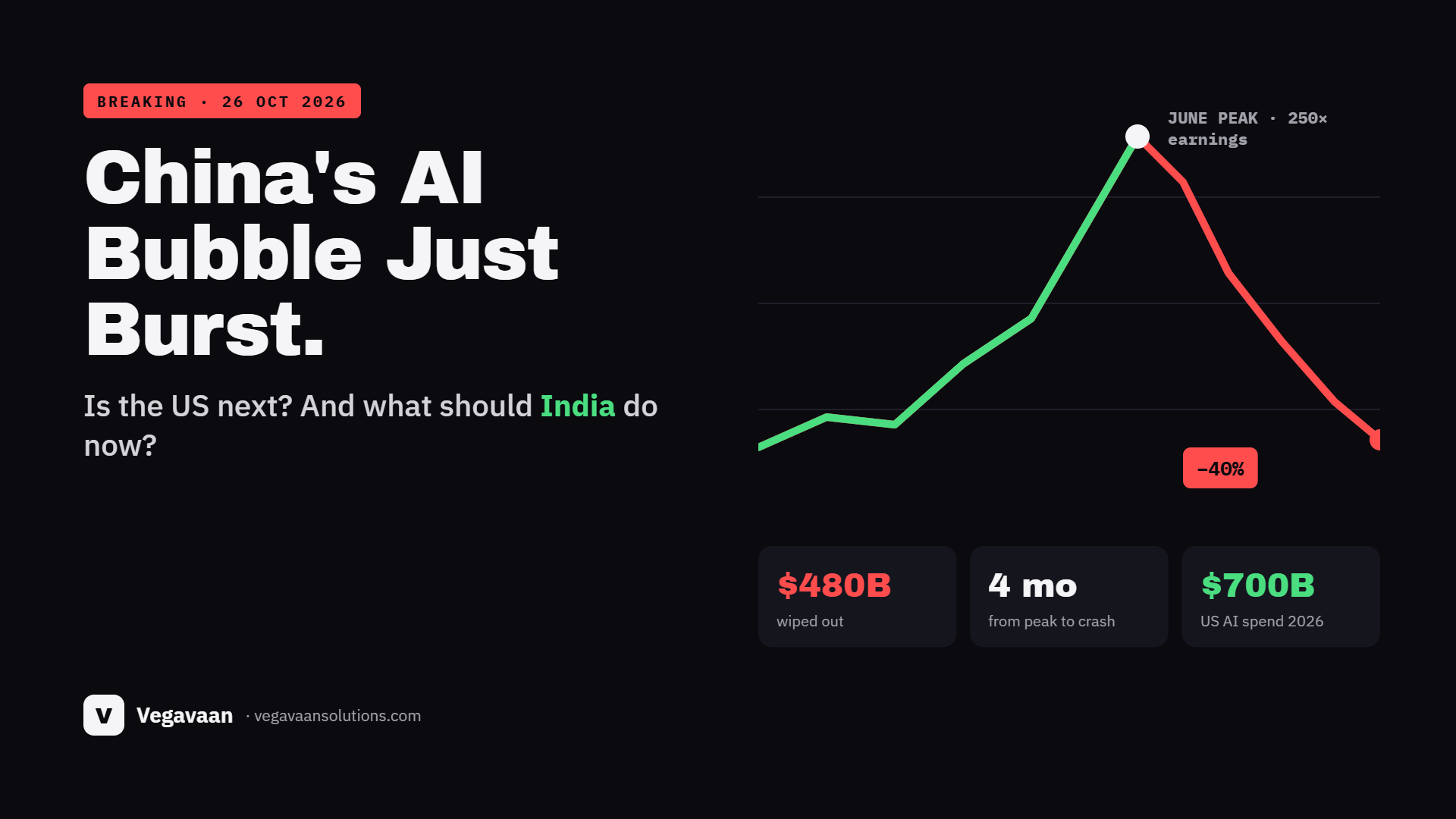
According to a Reuters analysis published on 26 October 2026, China's STAR 50 index, which is packed with AI and semiconductor companies, has fallen about 40% in under four months, wiping out roughly $480 billion in market value. Chip and robotics stocks that rose 400% to 700% after listing have lost half their value. Beijing fund managers are openly using the word "burst".
Meanwhile in the US, the four largest cloud companies are on track to spend about $700 billion on AI infrastructure this year. So is the American bubble next? And what does any of this mean for an Indian business owner, an IT company in Faridabad or Pune, or a developer worried about their job?
This article explains, in plain language, what happened in China, why it happened, whether the US is different, and the 7 practical lessons Indian businesses should take from it. No hype in either direction.
Contents
- Quick answer
- What actually happened in China
- Why China's AI bubble burst first
- Is the US AI bubble next? The numbers
- What it means for India
- 7 lessons for Indian businesses
- What the bubble does not mean
- Frequently asked questions
Quick answer
China's AI stock bubble has deflated sharply: the STAR 50 index fell about 40% from its peak, losing around $480 billion, after valuations reached roughly 250 times earnings, data centres sat underused and US restrictions hit Chinese AI suppliers. The US AI boom is also stretched (record capital spending, high valuations), but it is backed by real revenue growth at companies like Microsoft, Google and Alibaba. For India, the likely outcome is cheaper AI models and chips, more pressure on IT services pricing, and a clear lesson for businesses: buy AI for measurable results, not for the headline.
What actually happened in China
| Indicator | What happened |
|---|---|
| STAR 50 index (AI and chip stocks) | Down about 40% in under four months; roughly $480 billion in value erased |
| CSI 300 (blue chips) | About 20% below its June peak |
| Valuations | STAR 50 traded near 250 times trailing earnings at the peak; now near 100 times. The Nasdaq 100 is around 30 times |
| Unitree (robotics) | IPO was 8,000 times oversubscribed by retail investors; shares have roughly halved since August |
| Moore Threads, MetaX (chips) | Rose 400% and 700% after listing; have lost about half their value since July |
| Zhongji Innolight, Eoptolink (AI networking) | Down about 60% from their summer peaks after moves in Washington to bar them from US data centres |
| How big AI was in the market | Per Goldman Sachs, AI stocks were 42% of China's market capitalisation and 57% of trading turnover |
| Who got hurt | Mostly small retail investors, who dominate China's market |
One Beijing fund manager told Reuters the market had become "a speculative bull" and the bubble is bursting. Another predicted that Chinese chipmakers and AI suppliers will end up in a price war.
Why China's AI bubble burst first
- Prices ran far ahead of profits. At 250 times earnings, a company needs decades of perfect growth to justify its price. Nothing is perfect for decades.
- Overbuilding. An MIT Technology Review investigation found many Chinese data centres underused, badly located or built for older AI workloads. Local governments competed to build, the way they once competed to build apartments.
- DeepSeek changed the maths. When DeepSeek showed in 2025 that strong models could be trained with far less computing power, every company that had overspent on hardware suddenly looked exposed.
- Export restrictions both ways. US moves to keep Chinese networking equipment out of American data centres hit suppliers directly, while China's own export curbs on AI technology limited their markets.
- A retail-driven market. When small investors chase a theme with borrowed money, the rise is fast and the fall is faster. Regulators are now cracking down on leveraged and high-frequency trading.
- Price wars already visible. Chinese AI models are being sold for a fraction of US prices (Alibaba's models at about $0.60 per million output tokens versus $9 to $30 for leading US models, according to the CEPR AI Bubble Monitor). Cheap for customers, brutal for margins.
Is the US AI bubble next? The numbers
Here is the honest picture, with the case on both sides.
| Signs of a bubble | Signs it is different |
|---|---|
| The four biggest US cloud companies are on track for about $700 billion of capital spending in 2026, projected to consume about 92% of their operating cash flow (up from 41% in 2023) | Microsoft reports an AI business running at more than $37 billion a year; Google Cloud's order backlog has passed $460 billion |
| Nvidia's market value has been near $5 trillion; overall US market value is about 2.5 times GDP | US AI stocks trade around 30 to 37 times earnings, far below China's 100 to 250 times |
| Ray Dalio warned in October 2026 that the AI bubble is approaching its burst point | Revenue from AI cloud services is growing fast even in China: Alibaba's AI cloud revenue rose 45% to $7.1 billion last quarter; Baidu's AI infrastructure sales rose 50% |
| Productivity growth needed to justify valuations is estimated at 4–5% a year; actual recent growth is about 1–2% | The Nasdaq fell only about 6% from its record while China's STAR 50 fell 40% |
Our read: China had a stock bubble around AI. The US has an investment boom that may or may not pay back. The technology itself is not a bubble: usage keeps rising, and the companies selling AI capacity are collecting real money. What may deflate is the price investors pay for that future, and the weakest, debt-heavy projects.
What it means for India
- AI is about to get cheaper. Price wars in China and heavy competition in the US mean model prices, cloud GPU rents and eventually chips get cheaper for Indian buyers. Good news if you are building AI into your business.
- Indian IT services face pricing pressure, not extinction. Clients already ask for 20–30% price cuts on AI-affected work. Firms that resell "AI transformation" hype will struggle; firms that deliver measurable automation will win. Read our analysis of Indian IT layoffs and AI.
- Indian startups will find it harder to raise money on an "AI" label alone. After China, investors everywhere will ask for revenue, not slide decks.
- Hardware and data centre plans need realism. India is building data centres fast. China's underused facilities are a warning: build for actual demand, in the right locations, with power and cooling planned.
- Stock market investors: Indian AI-themed stocks and funds are not immune to global sentiment. This is not financial advice, but valuations matter.
7 lessons for Indian businesses
- Buy outcomes, not AI. Do not approve a project because it says "AI". Approve it because it saves 20 hours a week, answers every lead in 5 minutes or cuts errors by half. Our guide to using AI in a small business lists projects with clear returns.
- Start small and measure. One WhatsApp chatbot, one document automation, one AI voice agent, with a 30-day pilot and numbers before and after. See what AI agents cost in India.
- Do not lock yourself to one model or vendor. Prices are falling and leaders change. Build so you can switch models.
- Rent before you buy. Do not buy GPUs or build private AI infrastructure unless you have constant, proven workloads. Cloud capacity is getting cheaper every quarter.
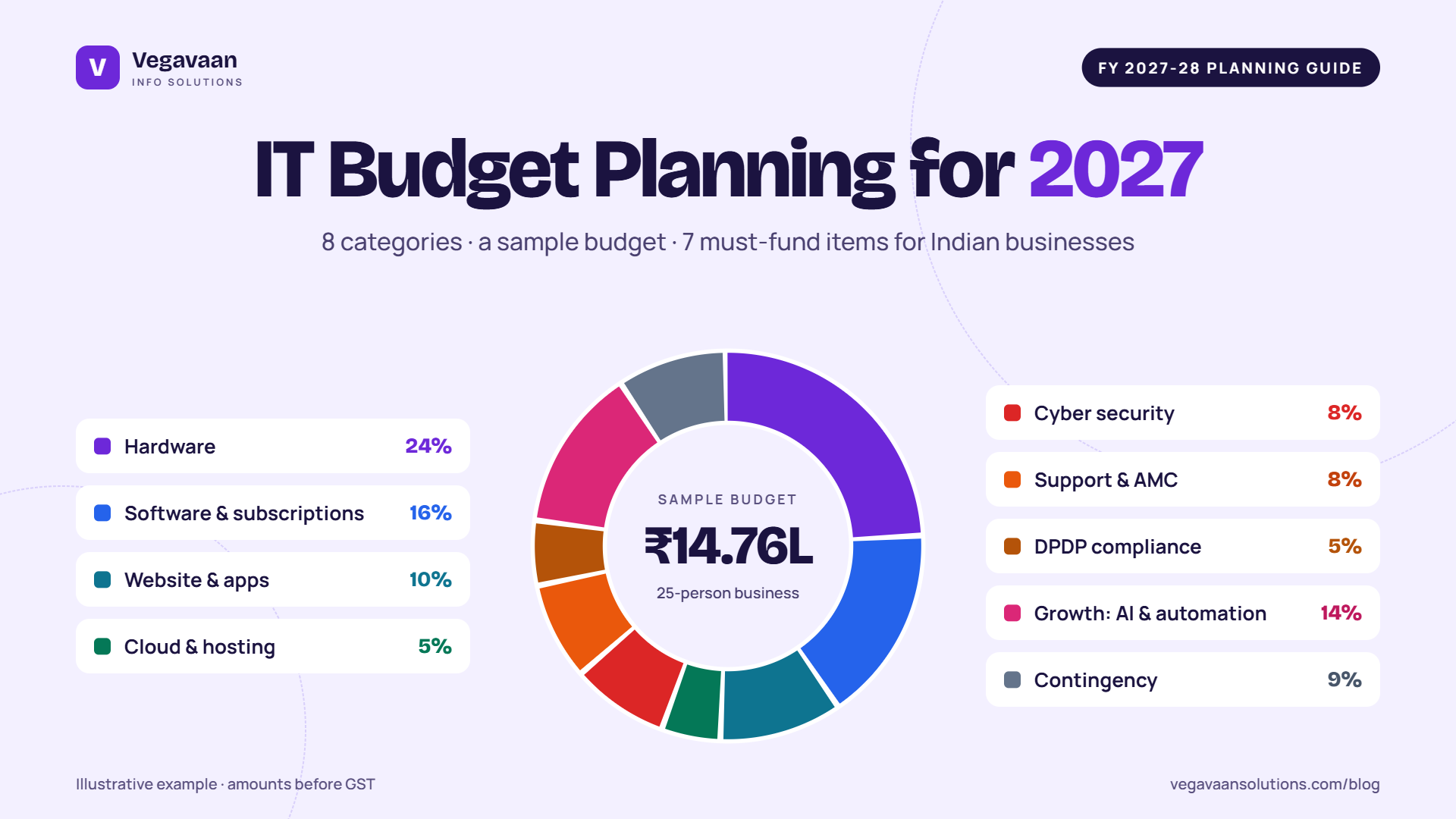
- Protect the basics first. Security, backups, DPDP compliance and a working website produce more return than a speculative AI project. See our IT budget guide for 2027.
- Keep humans in control. China's crash shows what happens when hype outruns reality. In your business, AI should suggest and humans should decide, especially for payments, legal and medical decisions.
- Ignore the noise, keep the skills. Whether or not stocks fall, the ability to use AI well is becoming a basic business skill, like email or Excel. Train your team now while tools are cheap.
What the bubble does not mean
- It does not mean AI "failed". Usage and AI revenue are rising, including in China.
- It does not mean Indian businesses should stop adopting AI. It means they should adopt it like any other tool: for results.
- It does not mean every AI company will collapse. In 2000, the dot-com crash took out hundreds of companies, but Amazon and Google came out of the same period.
How Vegavaan can help
Vegavaan Info Solutions helps Indian businesses adopt AI the sensible way: a short discovery, one well-chosen project with measurable goals, and a build that is not locked to a single vendor. Explore our AI solutions or book a free AI readiness call.
Frequently asked questions
Has the AI bubble burst?
In China's stock market, largely yes: the STAR 50 index of AI and chip stocks fell about 40% from its peak, losing about $480 billion. In the US, valuations and spending are stretched, but AI revenue is still growing strongly, so the picture is mixed.
Why did China's AI stocks crash?
Extreme valuations (near 250 times earnings), overbuilt and underused data centres, cheaper training methods shown by DeepSeek, US restrictions on Chinese AI suppliers, price wars and a retail-driven market that unwound quickly.
Will the AI bubble burst in the US too?
Nobody knows. Warning signs include record capital spending and high valuations; counter-signs include rapidly growing AI revenue at Microsoft, Google and others. Many analysts expect a correction in the weakest companies rather than a collapse of the sector.
What does the AI bubble mean for India?
Cheaper AI models and hardware, more price pressure on IT services, tougher fundraising for "AI-label" startups, and a reminder for businesses to invest in AI for measurable results.
Should my business stop investing in AI?
No. Invest in small, measurable projects with clear returns, avoid buying expensive hardware you do not need, and keep the ability to switch vendors as prices fall.
Conclusion
China's AI crash is not the end of AI. It is the end of paying any price for the word "AI". For Indian businesses, that is good news: the tools are getting cheaper, the hype is getting quieter, and the companies that use AI for real results will stand out even more.
Want to use AI for results, not headlines? Talk to Vegavaan.
Sources: Reuters analysis via Kathmandu Post: In China, the AI bubble has already burst (27 Oct 2026); Techweez: China's AI bubble bursts as tech stocks lose $480 billion (28 Oct 2026); CEPR: AI Bubble Monitor; Bloomberg: Ray Dalio warns AI bubble is approaching burst point (7 Oct 2026).