
Updated: 29 October 2026
Every week brings a new headline: TCS cuts thousands of jobs. Oracle, Amazon and Meta announce layoffs. Hiring at India's top IT firms falls to multi-year lows. And in every comment section, the same question: is AI taking Indian IT jobs?
The honest answer is more interesting than either "yes, it is over" or "no, nothing has changed". This article puts the real numbers in one place, explains which roles are being cut and which are being hired, and gives practical advice for three groups: freshers, mid-career IT professionals, and business owners who buy IT services.
Contents
- Quick answer
- The numbers: layoffs and hiring in 2026
- Why this is happening
- Roles being cut vs roles being hired
- How much of this is really AI?
- If you are a fresher
- If you are 5–15 years into your career
- If you run a business that buys IT services
- 7 skills that still pay in 2027
- Frequently asked questions
Quick answer
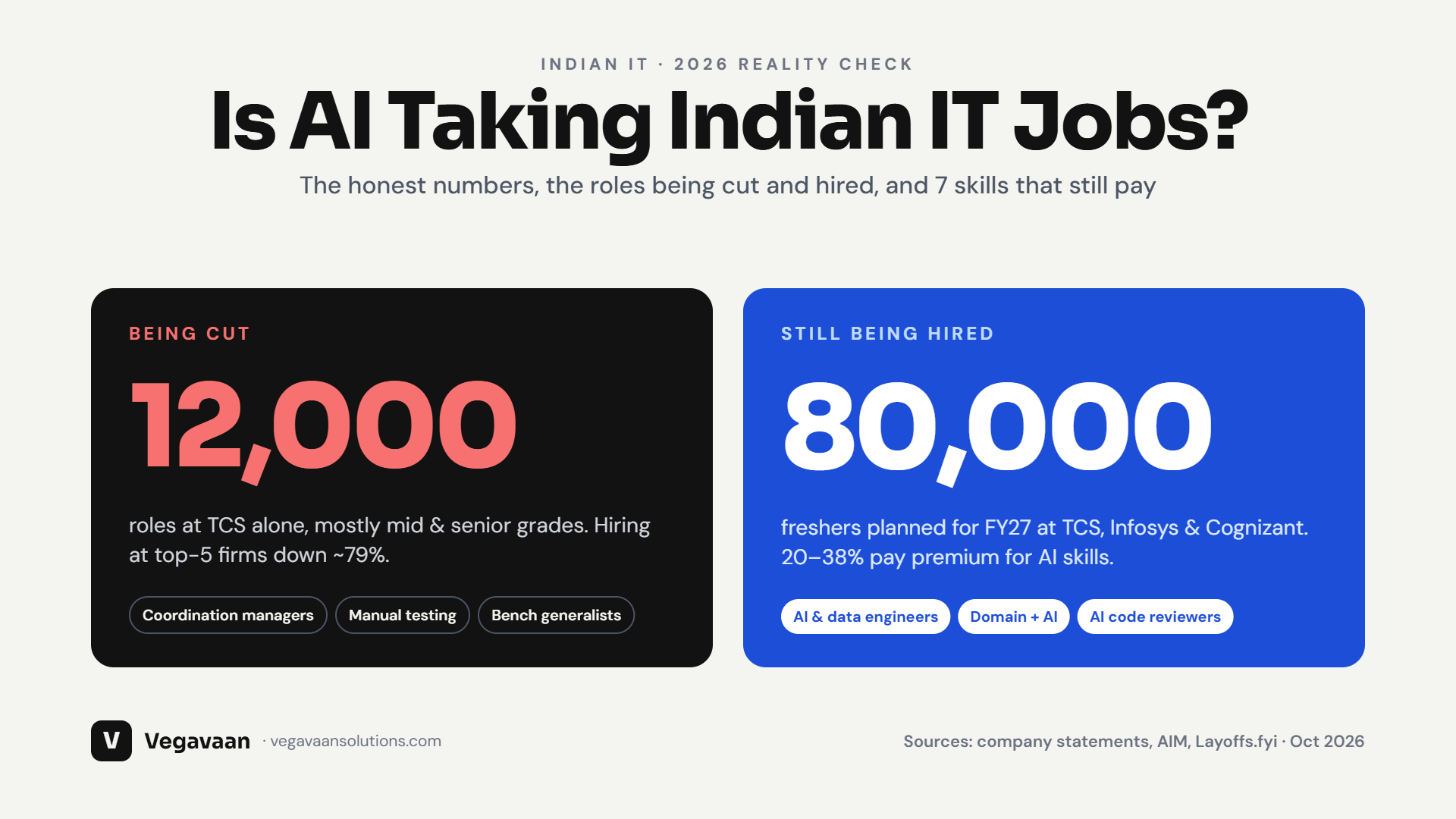
Indian IT is not collapsing, but it is changing shape. In 2026, large IT firms have cut thousands of mainly mid-level and senior roles (TCS alone announced about 12,000, roughly 2% of its workforce), hiring has fallen sharply from earlier years, and clients are asking for 20–30% price cuts on work that AI can speed up. At the same time, firms still plan to hire tens of thousands of freshers for FY27, and demand for AI, data, cloud and domain-plus-AI skills is rising. AI is a real driver, but so are weak demand, cost pressure and years of over-hiring. The people most at risk are generalists without hands-on or niche skills; the people most in demand can supervise, debug and apply AI in a specific domain.
The numbers: layoffs and hiring in 2026
Figures below come from company statements and published trackers; different sources count differently, so treat them as indicative.
| Data point | Figure | Source |
|---|---|---|
| TCS job cuts announced | About 12,000 roles, roughly 2% of a 613,000+ workforce, mainly middle and senior grades | Company statements, reported July 2026 |
| TCS headcount, Q2 FY26 (Jul–Sep 2025) | Fell by about 19,755 in one quarter, the largest quarterly decline in its history, even while hiring about 18,500 | Analytics India Magazine, Oct 2025 |
| Hiring at top five Indian IT firms | Down about 79% in H1 FY26 versus the previous year | Moneycontrol, cited by AIM |
| Global tech layoffs, 2026 to date | Roughly 128,000–135,000 roles (Oracle, Amazon, Meta, Nokia, Dell among the largest) | Layoffs.fyi and trackers, Sep 2026 |
| India tech role reductions, 2026 | Estimates range widely, from a few thousand directly tracked to 25,000–35,000 including MNC offshore units | Staffing analysts, Sep 2026 |
| Fresher hiring plans, FY27 | About 80,000 across TCS (~40,000), Infosys (~20,000) and Cognizant (~20,000) | Company statements, Jul 2026 |
| Attrition | 12.6%–14.9% at the top four firms, the lowest in nearly five years | Q2 FY26 results |
| Global capability centres (GCCs) in India | About 2,117, projected to add over 1.2 lakh roles this year | Nasscom and Zinnov; industry estimates |
| AI talent gap | About 2.3 million AI-linked openings in India by 2027 versus about 1.2 million qualified specialists | Bain and Company |
Read the table twice. Layoffs and hiring are happening at the same time. That is the whole story: the industry is swapping one kind of worker for another.
Why this is happening
- Clients want the AI discount. Clients are seeking 20–30% price cuts on work that AI can speed up, such as testing, maintenance and routine coding. Less revenue per project means fewer people per project.
- Pyramids are flattening. The old model needed many juniors for every senior. AI tools let small teams do the work of large ones, so coordination-heavy middle management is squeezed.
- Over-hiring in 2021–22. Firms hired aggressively during the pandemic boom. Some of today's cuts are a correction of that.
- Weak demand. Global clients delayed decisions and project starts through 2025–26, as TCS's CEO noted.
- Productivity per employee is the new metric. HCLTech, for example, reported rising revenue per employee and shortened a $1 billion transformation project from five years to three and a half using AI.
Roles being cut vs roles being hired
| Being cut | Being hired |
|---|---|
| Coordination-heavy middle management | AI, data and cloud engineers |
| Senior profiles without current hands-on or niche skills | Domain specialists (banking, insurance, healthcare, compliance) who can supervise AI output |
| Routine maintenance, manual testing and manual-process roles | Engineers who can debug and review AI-generated code |
| Generalists on the bench with no domain or technology focus | IT operations, platform and service-management staff |
| Roles built around "bench" capacity for projects that may not come | Freshers who show proof of work: projects, simulations, AI-tool fluency |
Pay follows the same pattern. Surveys cited in July 2026 report a 20–38% pay premium for AI skills, and Infosys has been reported to pay up to ₹21 lakh a year for engineers with advanced AI skills.
How much of this is really AI?
Companies disagree with each other. TCS says AI has not affected fresher hiring and reports over 114,000 employees with higher-order AI skills. Microsoft openly attributed 15,000 layoffs to AI-driven efficiency. Infosys's Topaz platform and similar tools reduce volume hiring by automating delivery.
A fair summary: AI is the accelerator, not the only engine. Weak demand and over-hiring created the need to cut; AI determined which roles could be cut without hurting delivery. That is why the cuts land on routine and coordination work, not on people who build and supervise systems.
If you are a fresher
- The door is open but narrower. About 80,000 fresher roles are planned at three firms alone. Competition is for proof, not degrees.
- Build 3 real projects you can demo: one web or mobile app, one data or automation project, one that uses an AI API or agent framework. Put them on GitHub with a clear README.
- Learn to work with AI coding tools, and more importantly, to find and fix their mistakes. Interviewers increasingly test this.
- Pick a domain early: banking, healthcare, logistics, retail. Domain plus AI is the combination firms are paying for.
- Look beyond the big five: GCCs, product startups and mid-sized IT companies are hiring, often with better learning curves. Our guide to software companies in Faridabad explains what smaller firms look for.
If you are 5–15 years into your career
- Get hands-on again. The most exposed profile is the senior person who only coordinates. Ship something yourself this quarter.
- Own an AI outcome at work: automate a report, build an internal agent, cut a process from days to hours, and document the result. That line on your CV is worth more than a certification.
- Convert experience into supervision. You know how systems fail. That is exactly the skill needed to review AI output in production.
- Learn the security side. AI agents create new risks; people who can secure them are scarce. See our AI agent security rules.
- Keep your network warm before you need it, especially in GCCs and product companies.
If you run a business that buys IT services
- Expect and ask for better prices on routine work: testing, maintenance, content, data entry. AI has changed the cost.
- But pay for judgement. Architecture, security, domain understanding and accountability have not become cheaper. Do not pick the lowest quote for anything that touches money or customer data.
- Ask vendors how they use AI and how they review AI-generated code. A good answer includes testing, security review and human sign-off.
- Smaller teams can now deliver what used to need large ones. This is good news for SMEs: custom software and AI projects that were out of reach are becoming affordable. See our guides on app development cost and AI agent cost in India.
7 skills that still pay in 2027
- AI engineering: building with LLM APIs, agents, retrieval and evaluation
- Data engineering and analytics: clean data is what makes AI useful
- Cloud and platform operations: running systems reliably and cheaply
- Cyber security, including AI security
- Domain expertise plus AI: finance, healthcare, compliance, supply chain
- Reviewing and debugging AI output: the quality gate every company now needs
- Product thinking and communication: turning a business problem into a buildable, measurable project
How Vegavaan can help
Vegavaan Info Solutions is a Faridabad-based IT and AI company. We build web and mobile applications, AI agents and automation for Indian businesses with small, senior teams that use AI tools responsibly, with human review and security built in. If you are a business owner looking for the new, more affordable way to get software built, talk to us. If you are an engineer who ships, say hello too.
Frequently asked questions
Is AI taking IT jobs in India?
Partly. AI is reducing demand for routine, coordination-heavy and manual-process roles while increasing demand for AI, data, cloud and domain-plus-AI skills. Weak client demand and earlier over-hiring are also major reasons for the 2026 layoffs.
How many people has TCS laid off in 2026?
TCS announced cuts of about 12,000 roles, roughly 2% of its workforce, mainly in middle and senior grades. Its headcount also fell by about 19,755 in a single quarter in late 2025, the largest quarterly decline in its history.
Are IT companies still hiring freshers?
Yes. For FY27, TCS, Infosys and Cognizant together plan to hire about 80,000 freshers, though overall hiring is well below the 2021–22 peak and selection is more skills-based.
Which IT skills are in demand in India in 2026–27?
AI engineering, data engineering, cloud and platform operations, cyber security, domain expertise combined with AI, reviewing AI-generated code, and product thinking.
Will Indian IT recover?
The industry is about $283 billion and still growing, but with fewer people per unit of revenue. Expect a different shape: smaller, more skilled teams, more GCC hiring, and more value from AI-driven delivery rather than headcount.
Conclusion
Indian IT is not dying; the old pyramid is. The winners of the next five years will be people who can build with AI, check its work and apply it to a real domain, and businesses that use the new economics to get better software at better prices. Pick a side of that change and prepare for it now.
Want to build with a team that already works this way? Talk to Vegavaan.
Sources: Analytics India Magazine: Indian IT is laying off employees and calling it restructuring; CareerCracker: TCS cut 12,000 jobs, Indian IT still plans 80,000 fresh hires; Gujarat Samachar: Tech layoffs 2026.