
Updated: 1 November 2026
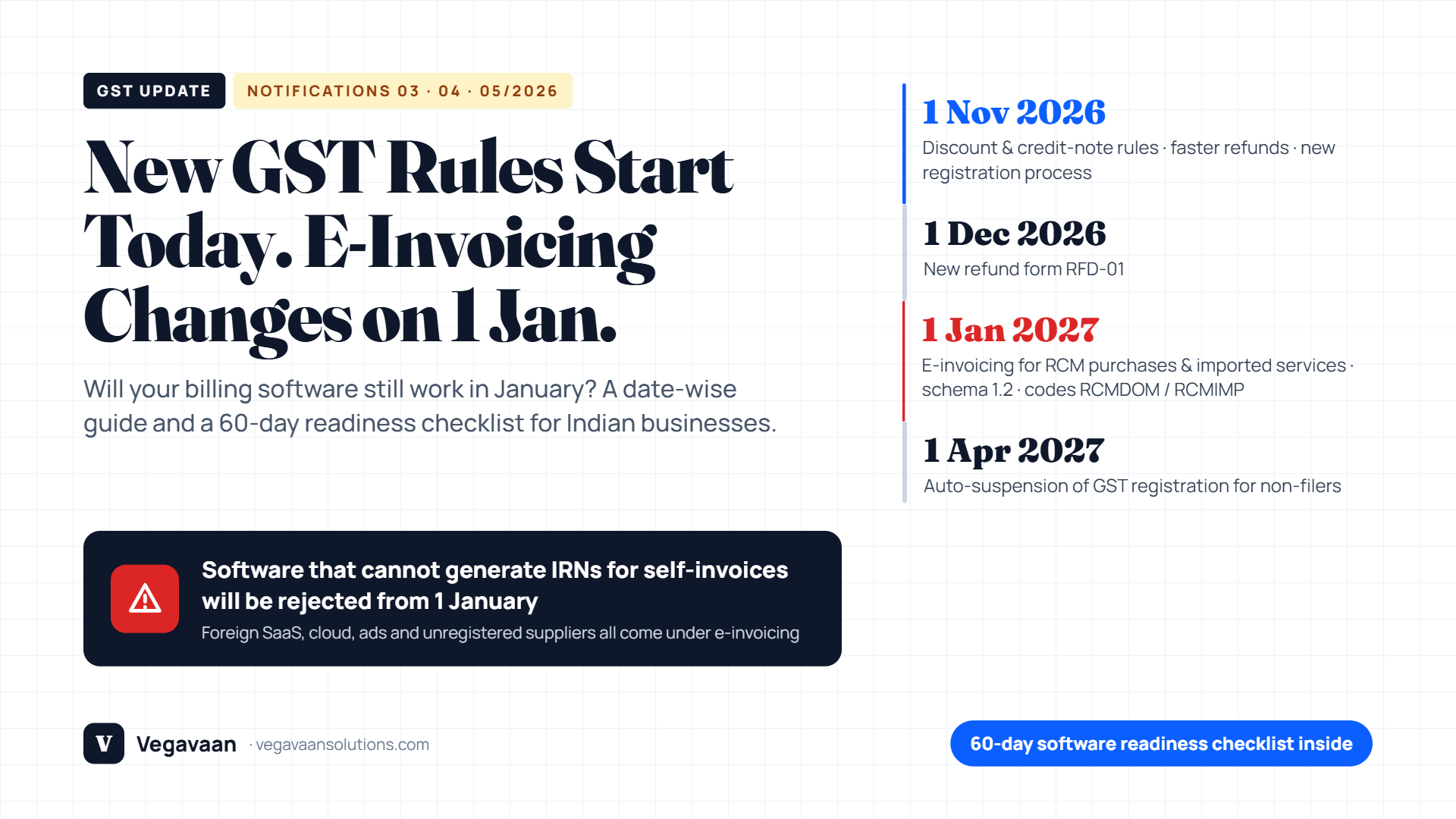
Three GST notifications issued on 26 October 2026 (Notifications 03, 04 and 05/2026–Central Tax) change how Indian businesses handle discounts, refunds, registration and, most importantly for anyone running billing software, e-invoicing. Most changes start today, 1 November 2026. The e-invoicing expansion starts 1 January 2027. Automatic suspension of GST registration for non-filers starts 1 April 2027.
Your CA will handle the law. This guide covers the part most businesses forget until a January morning when the invoice portal rejects a bill: what your billing, accounting and ERP software must be able to do, and by when. It includes a date-wise table, a 60-day software readiness checklist, and the questions to ask your software vendor this week.
This is a practical summary based on published notifications and professional commentary, not tax or legal advice. Confirm specifics with your CA and the official CBIC texts.
Contents
- Quick answer
- All the dates in one table
- E-invoicing from 1 January 2027: what changes
- What changes from 1 November 2026
- Automatic suspension from 1 April 2027
- What your software must do
- 60-day software readiness checklist
- 7 questions to ask your software vendor
- Frequently asked questions
Quick answer
From 1 November 2026, post-sale discounts can be excluded from taxable value through a credit note if the buyer reverses the related input tax credit; refund processing is faster, with acknowledgement within 10 days and 90% provisional refunds for inverted duty cases; and new registration and cancellation rules apply. From 1 January 2027, e-invoicing extends to reverse-charge purchases from unregistered suppliers and to imports of services, with a new e-invoice schema (version 1.2) and new supply-type codes. From 1 April 2027, the GST portal will automatically suspend registrations for prolonged non-filing or missing bank details. If your billing software cannot generate IRNs for self-invoices and does not support schema 1.2 by January, your invoices will be rejected.
All the dates in one table
| Date | What starts | Who should care |
|---|---|---|
| 1 Nov 2026 | New discount and credit-note rules; faster refund timelines; new registration (Rule 14B for e-commerce sellers), amendment and cancellation processes; input-service ITC counted in inverted-duty refunds | Every GST-registered business; distributors with dealer schemes; exporters; e-commerce sellers |
| 1 Dec 2026 | Revised refund form RFD-01 with new declarations and invoice-wise export details; some registration-amendment changes | Exporters and anyone claiming refunds |
| 1 Jan 2027 | E-invoicing extended to RCM supplies from unregistered persons and import of services; e-invoice schema 1.2 with new codes RCMDOM and RCMIMP | Businesses already under e-invoicing (currently those above the ₹5 crore turnover threshold) that buy from unregistered suppliers or import services, such as foreign software subscriptions, ads and consulting |
| 1 Apr 2027 | Automatic suspension and cancellation of registration for prolonged non-filing or missing bank details; ITC blocking through formal DRC-26 orders; capital-goods ITC in inverted-duty refunds; new demand-notice formats; revised GSTR-1 forms targeted | Every business, especially small ones that file late |
E-invoicing from 1 January 2027: what changes
Today, e-invoicing (generating an Invoice Reference Number, or IRN, through the government's Invoice Registration Portal) applies to B2B supplies and exports by businesses above the turnover threshold, which has been ₹5 crore since August 2023.
Notification 04/2026–Central Tax adds two new categories from 1 January 2027:
- Reverse-charge purchases from unregistered suppliers. When you buy goods or services from an unregistered person and you pay the tax under reverse charge, the self-invoice you raise will need an IRN.
- Import of services. Payments to foreign vendors for services (cloud and SaaS subscriptions, online advertising, overseas consultants, software licences, freelancers abroad) attract reverse-charge GST, and the self-invoice for them will also need an IRN.
To support this, the e-invoice schema moves from version 1.1 to version 1.2, with new supply-type codes: RCMDOM (domestic reverse charge from unregistered suppliers) and RCMIMP (import of services).
Why this catches businesses out: most companies generate e-invoices only for sales. Self-invoices for purchases are often made in Excel, on paper or not at all. From January, those documents go through the same portal, with the same validation and the same rejections.
What changes from 1 November 2026
- Post-sale discounts: a discount no longer has to be agreed before or at the time of supply to be excluded from taxable value. The supplier issues a credit note and the recipient reverses the related ITC. Dealer incentive schemes, year-end discounts and target bonuses become simpler, but your system must link credit notes to the original supplies and track the buyer's ITC reversal.
- Refunds: acknowledgement or deficiency memo within 10 days instead of 15; provisional refund orders within 3 working days; 90% provisional refund extended to inverted duty structure cases; input-service ITC counts toward inverted-duty refunds for credit availed from 1 November 2026.
- Registration: amendments through REG-14 within 15 days with deemed approval if the officer does not act; voluntary cancellation through REG-16 within 30 days only after all returns are filed; e-commerce sellers can register in a state using the platform's warehouse as principal place of business, subject to a ₹2.5 lakh monthly B2B output tax cap and the operator's consent.
Automatic suspension from 1 April 2027
From April 2027 the portal itself will suspend a registration when returns are not filed for the specified periods (for example, six continuous months of monthly returns or two continuous quarters) or when bank account details are missing. Filing within 30 days revokes the suspension; otherwise cancellation follows. A suspended registration means you cannot issue valid tax invoices and your customers cannot claim ITC on your bills. For small businesses that file late, this is the most dangerous change on the list.
What your software must do
| Requirement | Deadline | What to check |
|---|---|---|
| Discount-linked credit notes | 1 Nov 2026 | Credit notes reference original invoices; reports show which recipients have reversed ITC |
| New RFD-01 format | 1 Dec 2026 | Refund module produces the new declarations and invoice-wise merchant export details |
| IRN for self-invoices (RCM) | 1 Jan 2027 | Purchase module can raise a self-invoice for unregistered suppliers and send it to the IRP |
| IRN for import of services | 1 Jan 2027 | Foreign vendor bills (SaaS, ads, consultants) generate a self-invoice with IRN |
| E-invoice schema 1.2 | 1 Jan 2027 | Vendor confirms support for schema 1.2 and codes RCMDOM and RCMIMP |
| Return and due-date updates | Rolling | GSTR-4 and CMP-08 report goods, services and e-commerce services separately; GSTR-5 due date moves to the 13th |
| Filing and bank-detail alerts | Before 1 Apr 2027 | Dashboard warns before the portal's auto-suspension triggers |
| ITC blocking workflow | 1 Apr 2027 | System records DRC-26 blocking orders and DRC-27 objections |
If you still run billing on Excel, this is the moment to move. Our guide on when to replace Excel with software explains the options and costs.
60-day software readiness checklist
This week
- ☐ List every system that creates invoices, credit notes or purchase entries: billing software, ERP, e-commerce platform, custom apps, Excel
- ☐ Identify all purchases from unregistered suppliers and all foreign service vendors (cloud, SaaS, ads, freelancers)
- ☐ Email your software vendor the 7 questions below and ask for a written reply
By 30 November
- ☐ Confirm credit notes link to original invoices and ITC-reversal tracking works
- ☐ Update refund workflows for the new RFD-01
- ☐ Clean your vendor master: GSTIN status, registered vs unregistered, foreign vs domestic
By 20 December
- ☐ Install the vendor's schema 1.2 update, or get a committed release date in writing
- ☐ Test a self-invoice with IRN for one unregistered supplier and one imported service in the sandbox
- ☐ Train accounts staff on self-invoicing; set a monthly cut-off so January entries are not missed
Before 1 April 2027
- ☐ Set filing reminders and bank-detail checks to stay clear of automatic suspension
- ☐ Review any blocked ITC and prepare for the DRC-26/27 process
7 questions to ask your software vendor
- Will you support e-invoice schema 1.2 and the RCMDOM and RCMIMP codes before 1 January 2027? What is the release date?
- Can the system raise self-invoices for unregistered suppliers and imported services and push them to the IRP automatically?
- Do credit notes link to original invoices, and can I report ITC reversals by recipient?
- Is the new RFD-01 format supported from 1 December?
- Will the dashboard warn me before the portal's auto-suspension rules trigger?
- Is the update included in my annual maintenance, or is it a paid upgrade?
- If your product is discontinued or delayed, can I export all my data in a standard format?
If the answers are vague, you have two months to find out the hard way. Our IT budget guide for 2027 covers how to plan for compliance changes like this without surprises.
How Vegavaan can help
Vegavaan Info Solutions builds and updates billing, ERP and custom business software for Indian companies: e-invoicing integration with the IRP (including schema 1.2 and self-invoices), credit-note and ITC-reversal tracking, Tally and accounting integrations, and automated compliance alerts. If your current software vendor cannot confirm readiness, we can audit your systems and close the gaps before January.
👉 Book a free GST software readiness check or explore our workflow automation and IT consulting services.
Frequently asked questions
What GST changes apply from 1 November 2026?
New rules for post-sale discounts and credit notes, faster refund timelines including 90% provisional refunds for inverted duty cases, input-service ITC in inverted-duty refunds, and new registration, amendment and cancellation processes, including a route for e-commerce sellers to register using a platform's warehouse.
What changes in e-invoicing from 1 January 2027?
E-invoicing extends to reverse-charge supplies received from unregistered persons and to imports of services. The e-invoice schema moves to version 1.2 with new supply-type codes RCMDOM and RCMIMP.
Who has to generate e-invoices?
Businesses above the notified turnover threshold, which has been ₹5 crore in any financial year since 2017-18 (effective August 2023). From January 2027, those businesses must also generate IRNs for RCM self-invoices and imported services. Check the current threshold with your CA.
Does e-invoicing apply to foreign SaaS subscriptions and online ads?
From 1 January 2027, if your business is under e-invoicing and pays reverse-charge GST on imported services such as cloud subscriptions, software licences or overseas advertising, the self-invoice for those services will need an IRN.
What happens if my GST returns are late after April 2027?
The portal can automatically suspend your registration for prolonged non-filing or missing bank details. Filing within 30 days revokes the suspension; otherwise cancellation can follow.
Do I need new software for these changes?
Not necessarily, but your existing software must be updated for schema 1.2, self-invoice IRNs, linked credit notes and the new refund forms. Ask your vendor for written confirmation and test in the sandbox before January.
Conclusion
The November GST changes are mostly good news for businesses: simpler discounts, faster refunds and clearer registration. The January e-invoicing expansion is where software breaks if nobody checks. Use the 60-day checklist, get written answers from your vendor, and test before the holidays, not after.
Need a second opinion on your systems? Talk to Vegavaan.
Sources: Taxonation: GST Notifications 03, 04 and 05/2026–Central Tax explained; TaxGuru: E-invoicing extended to RCM supplies and service imports; CAclubindia: CGST Rules 2026 amended; Business Today: GST changes from November 1, 2026.