

Updated: October 2026
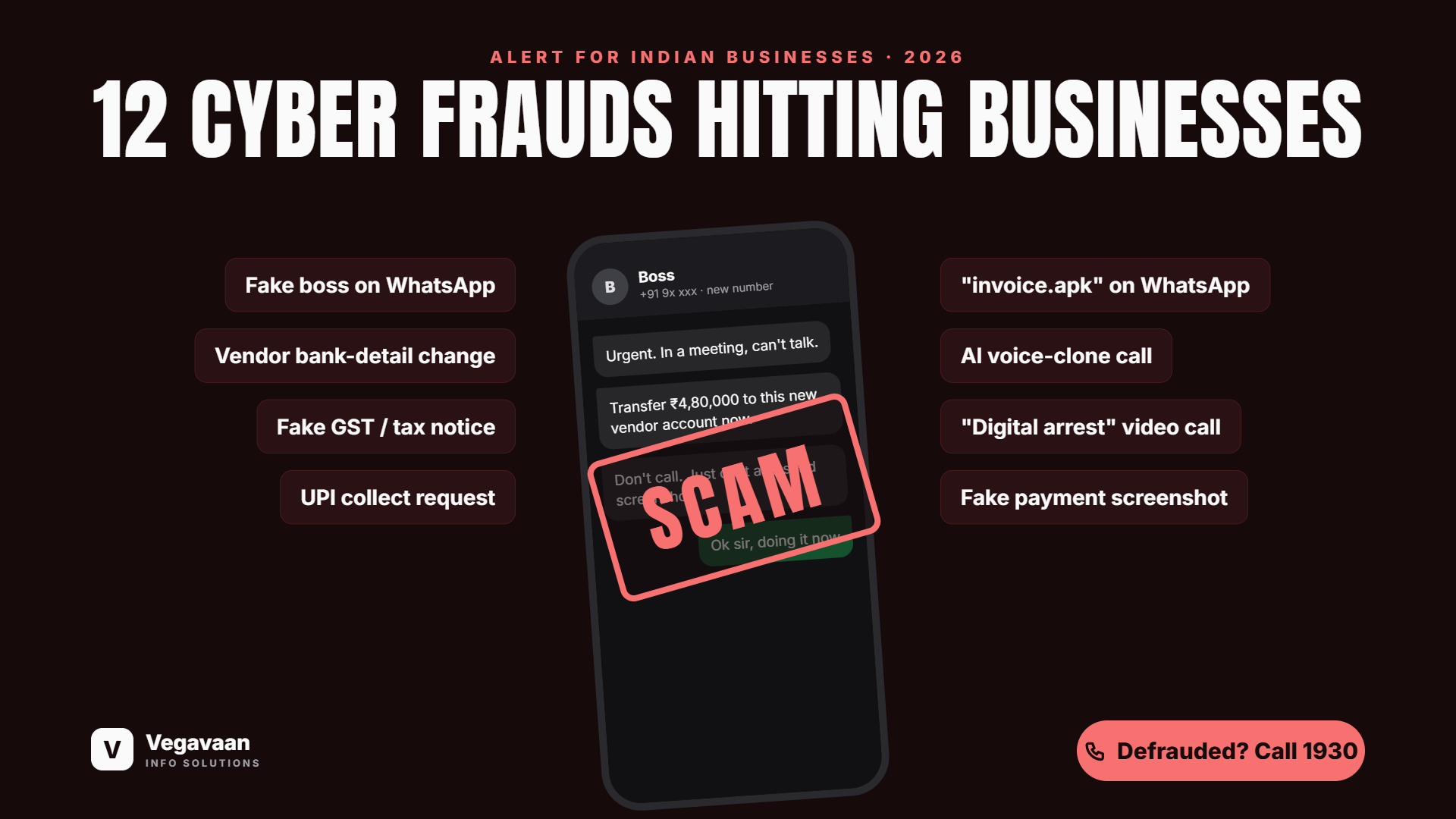
"Sir, please transfer ₹4,80,000 to this new account today, the vendor has changed banks." The message comes on WhatsApp, with the owner's photo and the right tone. The accountant pays. The real owner was in a meeting and never sent it.
Scenes like this play out in Indian businesses every week. According to government data reported by the Indian Cybercrime Coordination Centre (I4C), financial losses reported on the national cybercrime portal grew from about ₹551 crore in 2021 to about ₹22,848 crore in 2024, and complaints rose from about 2.6 lakh to over 19 lakh. Small and mid-sized businesses are attractive targets because payments move fast and there are few checks.
This guide explains the 12 most common cyber frauds targeting Indian businesses in 2026, how each one works, the warning signs, and the simple controls that stop them. It also tells you exactly what to do in the first hour if you are defrauded.
Contents
- Quick answer
- Cyber fraud in India: the numbers
- 12 cyber frauds targeting businesses in 2026
- 10 controls every business should have
- Defrauded? What to do in the first hour
- 5-minute staff training script
- Frequently asked questions
Quick answer
The most common cyber frauds against Indian businesses in 2026 are fake "boss" messages asking for urgent payments, fake vendor bank-detail changes, fake government notices, fake payment screenshots and UPI collect requests, malicious APK files on WhatsApp, AI voice-clone calls, "digital arrest" calls and remote-access scams. Stop them with a call-back rule for every payment or bank-detail change, two-person approval for transfers, multi-factor authentication, staff training and blocking unknown app installs. If you are defrauded, call 1930 or report at cybercrime.gov.in immediately and inform your bank.
Cyber fraud in India: the numbers
| Data point | Figure | Source |
|---|---|---|
| Reported financial cyber fraud losses | About ₹551 crore (2021) to about ₹22,848 crore (2024) | MHA / I4C via PIB |
| Fraud complaints | About 2.6 lakh (2021) to over 19 lakh (2024) | MHA / I4C via PIB |
| Share of losses from investment scams | About 77% | I4C data, as reported |
| "Digital arrest" complaints, Jan–Aug 2026 | Over 21,900 complaints involving over ₹647 crore | Centre's status report to the Supreme Court, October 2026 |
| Money restored through the Money Restoration Portal | ₹332.7 crore (from over 6 lakh refund requests) | Centre's status report to the Supreme Court, October 2026 |
The lesson in the last row: money can be recovered, but only if you report fast.
12 cyber frauds targeting businesses in 2026
1. The fake boss (CEO fraud) on WhatsApp
A new number with the owner's or director's photo messages the accounts team: "I'm in a meeting, can't talk. Make this urgent payment." Warning signs: new number, urgency, secrecy, "don't call me". Stop it: no payment on a chat instruction alone; always call back on the known number.
2. Fake vendor bank-detail change
Criminals hack or copy a supplier's email and send a genuine-looking invoice with "updated bank details". Your payment goes to their account. Stop it: verify every bank-detail change by calling the vendor on a number you already have, never the number in the email.
3. Fake GST, income tax or government notices
Emails or WhatsApp messages with official logos warn of penalties and include a link or attachment that steals logins or installs malware. Stop it: log in to the official portal directly to check notices; never click links in the message.
4. Fake payment screenshots and UPI "collect requests"
A "customer" shows an edited payment screenshot, or sends a collect request saying you will "receive" money when you enter your UPI PIN. Stop it: confirm payments only in your bank or UPI app or soundbox; remember that entering your UPI PIN always sends money, it never receives it.
5. QR code swap
Your printed shop QR is covered with a fraudster's QR. Stop it: check QR stickers daily and use a soundbox so you hear every payment.
6. Malicious APK files on WhatsApp
Files like "invoice.apk", "electricity_bill.apk" or "wedding_card.apk" install malware that reads OTPs and SMS. Stop it: never install apps from links or files; block "install unknown apps" on office phones.
7. AI voice-clone and deepfake calls
Fraudsters clone a senior person's voice from videos or calls and phone staff for an urgent transfer. Stop it: agree a code word or a call-back rule for any money request by phone.
8. "Digital arrest" calls
Callers pose as police, CBI, ED, customs or courier officials, claim the owner or an employee is involved in a crime and demand money to "clear" them, often over a video call. Stop it: no real agency arrests anyone on a video call or asks for money transfers. Disconnect and report on 1930.
9. Fake tech support and remote-access scams
A caller "from your bank", internet provider or software company asks you to install a remote-access app to "fix" a problem, then operates your banking. Stop it: never install screen-sharing apps on a caller's request.
10. Fake domain, website or listing renewal notices
Emails warn that your domain, website or Google listing will expire unless you pay now. Stop it: keep domains on auto-renew with a known registrar in your company's name, and pay only through your registrar's own dashboard.
11. Investment and "stock tips" groups targeting owners and staff
WhatsApp or Telegram groups promise high returns, show fake profits in an app and then block withdrawals. Investment scams are the largest share of reported losses. Stop it: invest only through SEBI-registered brokers and apps.
12. Overpayment and refund scams
A "customer" pays extra by mistake (often with a fake screenshot or a reversible payment) and asks for a refund of the difference. Stop it: refund only after the money is confirmed in your bank account, and only to the original payment source.
10 controls every business should have
- Call-back rule: every new payee, bank-detail change or urgent payment is confirmed by phone on a known number.
- Two-person approval for transfers above a set limit.
- Multi-factor authentication on email, net banking, GST and accounting logins.
- Separate device for banking, with no WhatsApp forwards, games or unknown apps.
- Payment limits per day and per transaction in net banking and UPI.
- Email protection: SPF, DKIM and DMARC on your domain so criminals cannot easily send email as you.
- Block unknown app installs on office phones and keep phones and computers updated.
- Domain and hosting in the company's name, on auto-renew, with two people who have access.
- Staff training every quarter, with real examples (see the script below).
- A written incident plan: who calls 1930, who calls the bank, who changes passwords.
For a full security plan, read our cybersecurity guide for Indian businesses. If you handle customer data, also see our DPDP compliance checklist, because personal data breaches must be reported under the DPDP rules from 13 May 2027.
Defrauded? What to do in the first hour
- Call 1930 (national cyber fraud helpline) or report at cybercrime.gov.in immediately. Fast reporting gives the best chance of freezing the money.
- Call your bank's fraud helpline and ask them to block the account or card and raise a fraud complaint.
- Save evidence: screenshots, chat, phone numbers, transaction IDs, emails and UPI IDs. Do not delete chats.
- Change passwords for email, banking and any account that may be exposed, and turn on MFA.
- Check devices for remote-access apps or unknown APKs, and remove them.
- Inform your team and vendors so the same trick does not work twice.
The government told the Supreme Court in October 2026 that the RBI has issued new customer-protection instructions, including shorter resolution timelines for fraudulent electronic transactions from 1 January 2027. In all cases, report to your bank and to 1930 / the national portal within days, not weeks.
5-minute staff training script
- "We never make a payment because of a WhatsApp message or email alone. We always call back on the known number."
- "Bank details never change by email. Call the vendor first."
- "Entering a UPI PIN always sends money. It never receives money."
- "Never install an app or APK from a link or file, and never install screen-sharing apps for a caller."
- "Police, CBI or customs never arrest anyone on a video call or ask for money transfers."
- "If something feels urgent and secret, stop and ask. You will never be blamed for checking."
How Vegavaan can help
Vegavaan Info Solutions helps Indian businesses close the gaps criminals use: email security (SPF, DKIM, DMARC), multi-factor authentication, secure websites and hosting, device policies, staff awareness sessions and regular security audits.
👉 Explore cyber security services or book a free fraud-risk check for your business.
Frequently asked questions
What is the cyber fraud helpline number in India?
Call 1930, the national cyber fraud helpline, or file a complaint at cybercrime.gov.in, the National Cyber Crime Reporting Portal.
What is CEO fraud?
CEO fraud is when criminals pretend to be a company owner or senior manager, usually on WhatsApp or email, and ask staff to make an urgent payment or share sensitive information.
Can money lost in cyber fraud be recovered?
Sometimes, yes, especially if it is reported quickly so banks can freeze the money. The government reported that ₹332.7 crore had been restored through the Money Restoration Portal by October 2026.
What is a digital arrest scam?
Fraudsters pose as police, CBI, ED or customs officers, claim the victim is involved in a crime and keep them on a video call while demanding money. Real agencies never do this.
How can a small business protect itself from cyber fraud?
Use a call-back rule for payments and bank-detail changes, two-person approval, multi-factor authentication, a separate banking device, payment limits, email protection and regular staff training.
Conclusion
Most business cyber frauds succeed through urgency and trust, not advanced hacking. A few simple rules (call back, two approvals, no APKs, report fast) stop the majority of them. Share this guide with your accounts team today.
Want help putting these controls in place? Talk to Vegavaan.
Sources: Free Press Journal: Centre's status report to the Supreme Court on digital arrest fraud; CyberPeace: the data behind India's digital fraud surge (citing MHA/I4C and PIB).