
App Development Cost in India 2026: Complete Price Guide (With AI Features)
Introduction
"How much does it cost to build an app?" is one of the first questions every founder, business owner and product manager asks. It is also one of the hardest to answer, because quotes from different companies can vary several times over for what sounds like the same app.
In 2026, the question has a new twist: almost every business now wants AI features in its app, such as a smart chatbot, document scanning, recommendations or voice support. That changes both the build cost and the monthly running cost.
In this guide, we break down what really drives app development cost in India, typical price ranges by app type, how AI features affect your budget, the hidden costs most people forget, and how to get an accurate quote without overspending.
Quick answer: how much does an app cost in India in 2026?
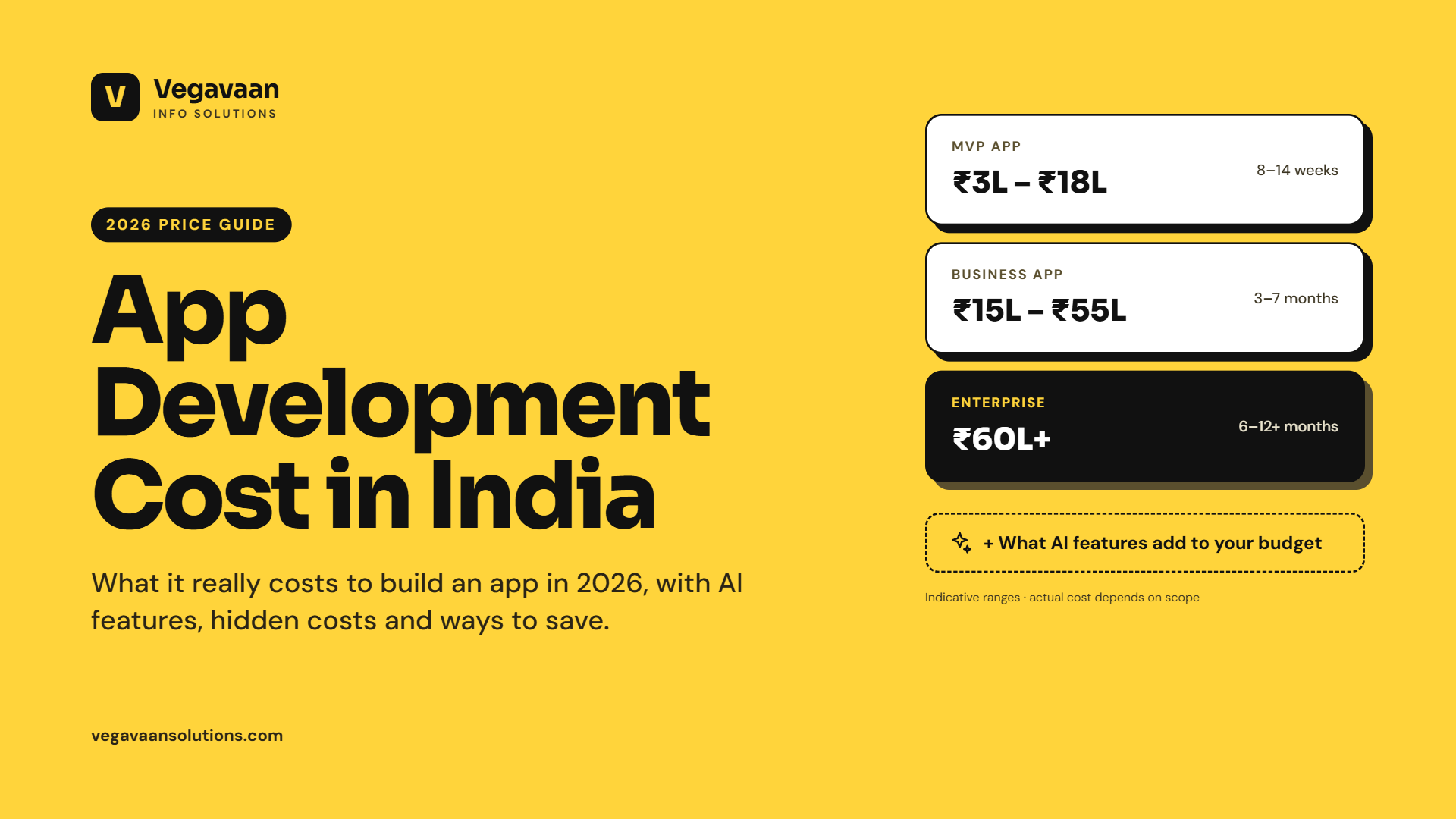
In 2026, a simple MVP app in India typically costs from about ₹3 lakh to ₹18 lakh, a mid-size business app from about ₹15 lakh to ₹55 lakh, and a large enterprise platform ₹60 lakh or more. The final price depends on features, platforms, design, integrations, AI capabilities and the team you hire.
These are indicative market ranges drawn from published Indian industry guides. Your actual cost can be lower or higher depending on scope.
App development cost by complexity
| App type | What it usually includes | Indicative cost (INR) | Typical timeline |
|---|---|---|---|
| Prototype / clickable demo | Screens and user flow to test an idea or pitch investors | ₹1.5 lakh – ₹4 lakh | 2–4 weeks |
| MVP (minimum viable product) | 3–5 core features, one platform or cross-platform, simple backend | ₹3 lakh – ₹18 lakh | 8–14 weeks |
| Mid-size business app | Android + iOS, payments, admin panel, notifications, integrations | ₹15 lakh – ₹55 lakh | 3–7 months |
| Enterprise platform | Multiple user roles, web + mobile, complex workflows, high security and scale | ₹60 lakh – ₹1.5 crore+ | 6–12+ months (usually in phases) |
Cost by type of app
Here is how common app categories usually compare, from lower to higher budget:
- Business information or catalogue app: lower budget, mostly content and enquiry forms.
- Booking and appointment app (clinics, salons, services): moderate, with calendars, reminders and payments.
- E-commerce app: moderate to high, with catalogue, cart, payments, order tracking and admin.
- Education / e-learning app: moderate to high, with video, quizzes, progress tracking and live classes.
- On-demand delivery app (food, grocery, services): high, because you often need separate customer, partner and admin apps plus live tracking.
- Fintech or healthcare app: high, due to security, compliance, KYC and data-protection requirements.
- Social or marketplace app: high, with real-time chat, feeds, moderation and scale.
What drives the cost of app development?
- Features and complexity: Login and profiles are simple; real-time chat, live tracking, recommendation engines and multi-role admin panels are not.
- Platforms: Android only, iOS only, both, plus a web app or admin dashboard. Cross-platform frameworks like Flutter and React Native can reduce cost compared with building two separate native apps.
- UI/UX design: A custom, research-led design costs more than a template, but usually pays back in better conversions and fewer redesigns.
- Backend and integrations: Payment gateways, maps, SMS, WhatsApp, CRMs and ERPs each add work. Indian industry guides put each third-party integration at roughly ₹50,000 to ₹2 lakh.
- AI features: Chatbots, document scanning, voice and predictions add development work and ongoing usage costs (see below).
- Security and compliance: Apps handling payments, health or personal data need extra security testing and alignment with India's DPDP Act.
- Team location and type: Freelancers, small studios and established development companies price very differently, as do teams in different countries.
- Testing and quality assurance: Proper manual and automated testing across devices prevents costly bugs after launch.
How much do AI features add to app cost?
AI is now the most requested add-on in app projects. It affects your budget in two ways: the one-time build cost and the monthly running cost.
| AI feature | What it does | Relative effort |
|---|---|---|
| AI chatbot / support assistant | Answers customer questions from your FAQs and documents | Low to medium |
| Document AI / OCR | Reads invoices, IDs, forms and receipts automatically | Medium |
| Smart search and recommendations | Suggests products or content based on user behaviour | Medium to high |
| Voice assistant | Lets users speak in Hindi, English or regional languages | Medium to high |
| AI agent | Completes tasks like bookings, refunds or CRM updates on its own | High |
| Predictive analytics | Forecasts demand, flags fraud or scores leads | High (depends on data quality) |
Do not forget running costs. Most AI features use cloud AI models that charge by usage. The more users and messages your app handles, the higher this bill. A good development partner will estimate your monthly AI cost before you build, and design the app to keep it under control.
Hidden costs most people forget
- Annual maintenance: Plan roughly 15–20% of the original development budget every year for updates, bug fixes and OS compatibility.
- Cloud hosting and servers: monthly charges that grow with your user base.
- App store fees: Google Play has a one-time developer registration fee, and Apple charges an annual developer programme fee.
- Third-party services: SMS, email, maps, payment gateway charges and WhatsApp messaging fees.
- AI usage costs: pay-per-use model and API charges.
- Security audits: periodic VAPT, especially for fintech, healthcare and e-commerce apps.
- Marketing and launch: app store optimisation, ads and onboarding campaigns.
- Contingency: keep 10–15% of the budget for changes discovered during testing.
Freelancer vs agency vs development company
| Freelancer | Small agency | Established development company | |
|---|---|---|---|
| Upfront cost | Lowest | Moderate | Moderate to higher |
| Skills covered | Usually one or two | Design + development | Design, development, AI, cloud, QA and security |
| Risk | Higher (single point of failure) | Medium | Lower, with processes and backup |
| Best for | Small fixes, simple prototypes | Simple to mid-size apps | Business-critical, AI-powered or scalable apps |
7 ways to reduce app development cost without cutting quality
- Start with an MVP. Launch with the 3–5 features users need most, then add more based on real feedback.
- Use cross-platform development (Flutter or React Native) when you need both Android and iOS.
- Write a clear requirement document before asking for quotes, so you compare like with like.
- Use proven services for payments, login, maps and messaging instead of building them from scratch.
- Prototype first. A clickable design catches expensive changes before any code is written.
- Add AI where it saves real time or money, not just because it is trendy.
- Choose a partner who includes testing and support, which avoids expensive rework later.
How to get an accurate app development quote
Before you contact development companies, prepare:
- A one-paragraph description of the problem your app solves and who it is for
- A list of must-have features versus nice-to-have features
- Target platforms (Android, iOS, web, admin panel)
- Any systems it must connect to (payment gateway, CRM, ERP, WhatsApp)
- Any AI features you want, and roughly how many users you expect
- Your target launch date and budget range
Then ask each company for a breakdown by module, the timeline, what is included in testing and support, and the estimated monthly running cost after launch.
How Vegavaan can help
At Vegavaan Info Solutions, we build Android, iOS and cross-platform apps, from MVPs to apps serving thousands of daily users. With 6+ years of experience, 50+ projects delivered and 30+ clients served, we bring design, engineering, AI, cloud and security together in one team.
- Mobile app development for Android, iOS and cross-platform
- UI/UX design with clickable prototypes before a line of code
- AI features: chatbots, document AI, voice agents and AI agents built into your app
- Cloud hosting and DevOps on AWS and Azure
- Quality assurance and security testing built into every release
👉 Get a free app cost estimate. Share your idea and we will send a feature-wise breakdown, timeline and estimate.
Frequently asked questions
How much does it cost to make an app in India in 2026?
A simple MVP typically costs about ₹3 lakh to ₹18 lakh, a mid-size business app about ₹15 lakh to ₹55 lakh, and an enterprise platform ₹60 lakh or more. The final cost depends on features, platforms, design, integrations and AI capabilities.
How much does it cost to add AI to an app?
It depends on the feature. A basic AI chatbot that answers from your documents is one of the more affordable additions, while AI agents, voice assistants and predictive analytics take more work. AI features also have monthly usage costs that grow with the number of users.
How long does it take to build an app?
A focused MVP usually takes about 2 to 3.5 months, a mid-size business app 3 to 7 months, and a large enterprise platform 6 to 12 months or more, often delivered in phases.
Is Flutter cheaper than native app development?
Often, yes. Flutter and React Native let one team build for Android and iOS from a single codebase, which usually reduces cost and time compared with two separate native apps. Native development can still be better for apps that need maximum performance or deep device features.
What is the yearly maintenance cost of an app?
A common rule of thumb is 15–20% of the original development cost per year, plus hosting, third-party services and any AI usage charges.
Conclusion
There is no single price for an app, but there is a smart way to plan one: define your core features, start with an MVP, budget for running and maintenance costs, and add AI where it creates real value. With the right partner, you can launch faster and spend your budget where it matters most.
Have an app idea? Talk to a Vegavaan expert and get a clear, feature-wise estimate.
Cost ranges are indicative and based on published Indian industry pricing guides, including Riolabz and Zartek. Actual costs vary by scope and provider.