

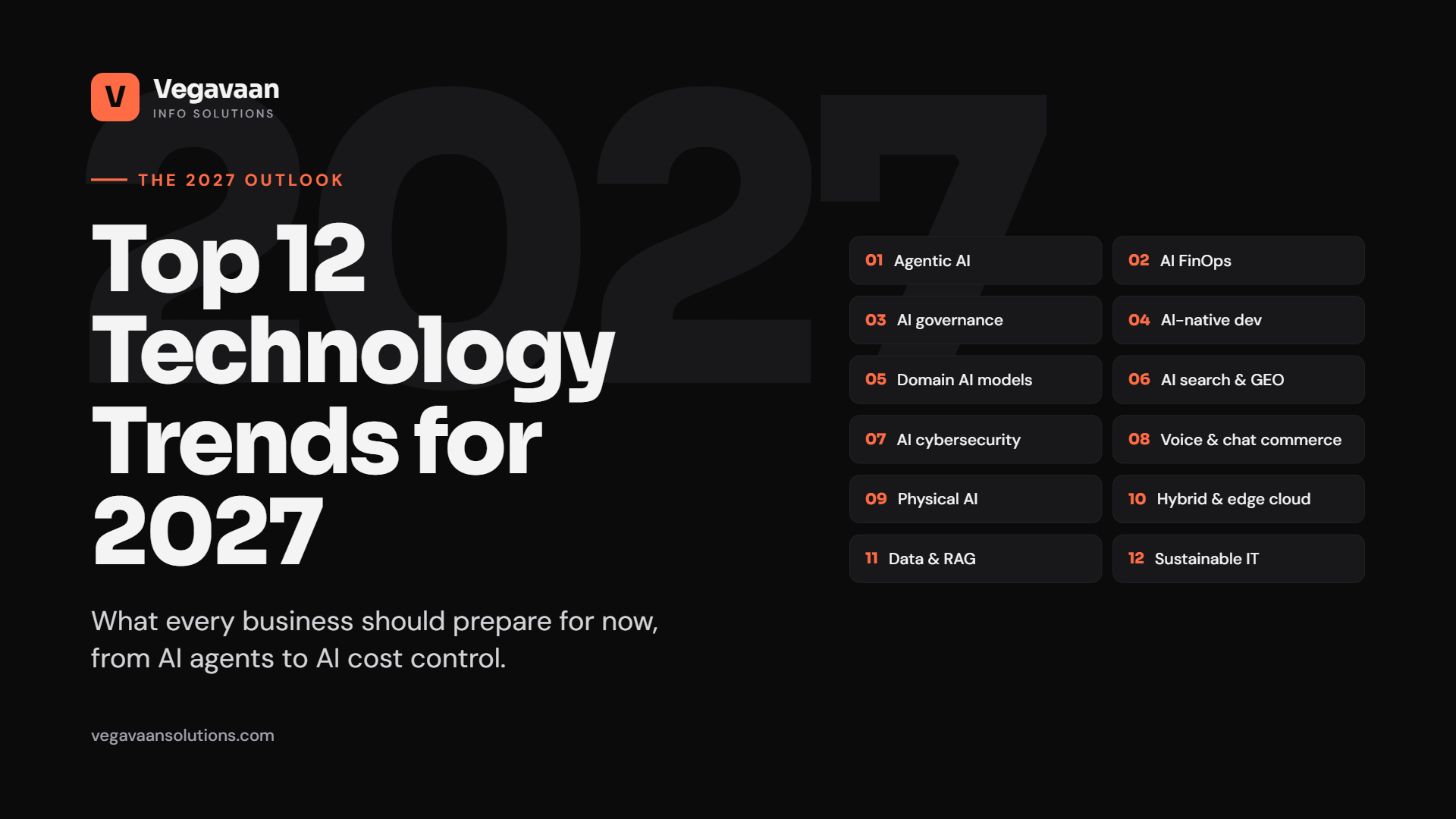
Top 12 Technology Trends for 2027: What Every Business Should Prepare for Now
Introduction
Every year, business leaders ask the same question as the year comes to a close: which technologies will matter next year, and which ones can we safely ignore?
The answer for 2027 is clearer than usual. Artificial intelligence is moving from chat windows into everyday operations, AI agents are starting to do real work, cyber threats are growing more automated, and companies are under pressure to show measurable returns on their technology spending.
In this guide, we break down the top 12 technology trends for 2027: what each one means in plain language, why it matters, which industries it affects most and what you can do about it today. Whether you run a startup, an SMB or a large enterprise in India or anywhere else, this is your practical roadmap for the year ahead.
Quick summary: the 12 tech trends shaping 2027
| # | Trend | What it means for business |
|---|---|---|
| 1 | Agentic AI and multi-agent systems | AI that completes multi-step tasks, not just answers questions |
| 2 | AI cost control (AI FinOps) | Tracking and optimising what AI really costs versus the value it creates |
| 3 | AI governance and responsible AI | Rules, audits and accountability for how AI is used |
| 4 | AI-native software development | Faster, cheaper app building with AI coding tools |
| 5 | Domain-specific AI models | AI trained for your industry, language or data |
| 6 | AI search and GEO | Being found and cited in AI answers, not just search results |
| 7 | AI-powered cybersecurity | Using AI to fight AI-driven attacks |
| 8 | Conversational commerce and voice AI | Selling and serving on WhatsApp, chat and voice |
| 9 | Physical AI and robotics | AI in robots, drones and smart machines |
| 10 | Hybrid cloud, sovereign cloud and edge computing | Where your data and AI run, and who controls it |
| 11 | Data readiness and RAG | Clean, connected data as the fuel for useful AI |
| 12 | Sustainable and energy-aware IT | Managing the energy cost of AI and data centres |
1. Agentic AI and multi-agent systems
What it is: Agentic AI is AI that can take a goal, plan the steps, use your software tools and complete the task, asking a human for approval where needed. Multi-agent systems go further: several specialised AI agents work together, for example one gathers data, one analyses it and one drafts the report.
Why it matters in 2027: Agents are moving from pilots into real workflows such as customer support, finance operations, IT ticketing and sales. In its predictions for 2027 and beyond, Gartner goes as far as forecasting that by the end of 2030 more than 10 billion autonomous agents will be filing applications and claims on people's behalf.
What to do now: Identify one repetitive, multi-step process and run a small proof of concept. Read our guide: Agentic AI: What It Is, Real Business Use Cases, and How to Get Started.
2. AI cost control and AI FinOps
What it is: As AI usage grows, so do bills for AI models, cloud computing and data. AI FinOps is the practice of tracking, forecasting and optimising AI spending, and linking it to business value.
Why it matters in 2027: Many companies built AI features quickly in 2025 and 2026 and are now asking, "What are we actually getting for this money?" Gartner predicts that by 2029, 60% of organisations deploying AI will create a dedicated function to map AI's total cost to value or profit, and that by 2028, 60% of Global 500 companies will build cost controls directly into how their AI runs.
What to do now: Measure cost per completed task (per ticket resolved, per invoice processed), not just total spend. Choose the right-sized AI model for each job.
3. AI governance and responsible AI
What it is: Policies, controls and audit trails that make sure AI is accurate, fair, secure and compliant.
Why it matters in 2027: As AI makes more decisions, customers, regulators and insurers want proof of how those decisions were made. Gartner expects insurers, not just regulators, to become a major driver of AI governance by 2030 through underwriting standards for AI liability cover. In India, the Digital Personal Data Protection (DPDP) Act adds clear obligations for any AI that handles personal data.
What to do now: Keep an inventory of where AI is used, log what AI agents do, and keep humans in the loop for high-impact decisions.
4. AI-native software development
What it is: AI coding assistants and AI-native platforms that help teams design, write, test and document software much faster.
Why it matters in 2027: Building software is getting faster and cheaper, which lowers the barrier to custom apps and internal tools. Gartner even predicts that by 2029, 80% of new applications will be built for short-term use of less than a year, a sign of how disposable and quick-to-build software is becoming.
What to do now: Revisit ideas you shelved because custom software seemed too expensive. Planning a project? See our app development cost guide on the Vegavaan blog.
5. Domain-specific AI models
What it is: AI models tuned for a specific industry (legal, healthcare, finance), language (Hindi and other Indian languages) or company dataset, instead of one general-purpose model for everything.
Why it matters in 2027: Specialised models are often more accurate, cheaper to run and easier to control for specific tasks, which matters for regulated sectors and multilingual markets like India.
What to do now: For your key use cases, compare general models with smaller or specialised ones on accuracy, speed and cost.
6. AI search and Generative Engine Optimization (GEO)
What it is: Customers increasingly get answers from Google AI Overviews, AI Mode, ChatGPT, Gemini and Perplexity. GEO is the practice of making your business the source these tools trust and cite.
Why it matters in 2027: Fewer searches end in a click to a website, so visibility inside AI answers is becoming as important as ranking on page one.
What to do now: Add clear answers, FAQs, schema markup and real expertise to your key pages. Full checklist: SEO in the Age of AI Search.
7. AI-powered cybersecurity
What it is: Security tools that use AI to detect threats, spot unusual behaviour and respond automatically, along with new defences for AI systems themselves.
Why it matters in 2027: Attackers use AI for convincing phishing, deepfake fraud and automated scanning. New risks are emerging too: Gartner predicts that by 2030, 80% of organisations with public-facing AI will face "cost exhaustion" attacks designed to drive up their AI bills.
What to do now: Get the basics right (MFA, patching, backups, training), add usage limits to public AI features, and run regular security audits. Read: Cybersecurity: How Indian Businesses Can Stay Safe from AI-Powered Attacks.
8. Conversational commerce and voice AI
What it is: Customers discovering, buying, booking and getting support through chat apps, voice assistants and AI agents instead of websites and call centres.
Why it matters in 2027: In markets like India, WhatsApp is already a primary business channel. AI now lets businesses reply instantly, in multiple languages, around the clock, and take actions like bookings and payments.
What to do now: Start with one high-volume conversation type, such as order status or appointment booking. Guide: WhatsApp AI Chatbots for Business.
9. Physical AI and robotics
What it is: AI that operates in the physical world through robots, drones, autonomous vehicles and smart machines.
Why it matters in 2027: Manufacturing, logistics, warehousing, agriculture and healthcare are adopting AI-driven machines for inspection, picking, delivery and monitoring. Gartner predicts that by 2030, 80% of front-line workers at international companies will be supported by physical AI systems.
What to do now: Look at tasks that are repetitive, dangerous or need constant monitoring, and start with vision-based quality checks or predictive maintenance.
10. Hybrid cloud, sovereign cloud and edge computing
What it is: Spreading workloads across public cloud, private infrastructure and edge devices, and choosing where data lives for reasons of cost, speed, regulation and control.
Why it matters in 2027: Data-protection laws, AI infrastructure costs and the need for low-latency AI are pushing companies to think carefully about where their applications and data run.
What to do now: Review where sensitive data is stored and processed, tighten cloud configurations, and right-size cloud spending.
11. Data readiness and RAG (retrieval-augmented generation)
What it is: Organising documents, databases and knowledge so AI can use them accurately. RAG lets AI answer from your own approved content, with sources.
Why it matters in 2027: The biggest reason AI projects fail is not the model; it is messy, scattered or outdated data. Companies with clean, connected data will get far more value from AI.
What to do now: Centralise key documents (policies, product data, SOPs), assign owners to keep them updated, and connect them to a knowledge assistant for staff or customers.
12. Sustainable and energy-aware IT
What it is: Designing technology to use less energy and track its environmental footprint, especially as AI increases computing demand.
Why it matters in 2027: AI and data centres are driving up electricity demand worldwide. Gartner even predicts that by 2030, large enterprises will own around $10 trillion in energy assets and become power providers themselves.
What to do now: Choose efficient AI models, shut down idle cloud resources and ask providers about the energy sources behind your hosting.
Which tech trends matter most for your industry?
| Industry | Top trends to prioritise in 2027 |
|---|---|
| Banking, fintech and payments | AI agents for KYC and operations, AI-powered fraud detection, AI governance |
| Healthcare | Voice AI for appointments, clinical note summarisation, data privacy and security |
| Education and e-learning | AI tutors, multilingual content, conversational support for students and parents |
| Retail and e-commerce | Conversational commerce, AI search visibility, demand forecasting |
| Manufacturing and logistics | Physical AI, predictive maintenance, edge computing |
| Legal and compliance | Domain-specific AI, contract review with RAG, AI governance |
| Government and public sector | Citizen service assistants, document digitisation, sovereign data handling |
| Small and mid-sized businesses | AI chatbots, AI-assisted marketing, cybersecurity basics, GEO |
How to build your 2027 technology roadmap in 5 steps
- Start with business goals, not tools. List the 3–5 outcomes that matter most next year: more revenue, lower costs, faster service or reduced risk.
- Map trends to those goals. Pick only the trends that directly support them. Ignoring the rest is a valid strategy.
- Fix your foundations. Clean data, secure systems and a modern cloud setup make every other trend easier and cheaper.
- Run small, measurable pilots. Test each idea in 2–6 weeks with clear success metrics before scaling.
- Build governance in from day one. Track costs, log AI decisions, protect data and keep humans in charge of high-impact actions.
How Vegavaan can help you prepare for 2027
At Vegavaan Info Solutions, we are an AI-first software engineering company helping businesses turn technology trends into practical results. With 6+ years of experience, 50+ projects delivered and 30+ clients served, one team covers:
- AI strategy and governance: readiness assessments and a prioritised 2027 roadmap
- Agentic AI, generative AI and RAG knowledge assistants
- AI chatbots and voice agents for web, WhatsApp and phone
- Cyber security and cloud computing on AWS and Azure
- Web and mobile app development, data analysis and SEO and AI search optimization
👉 Book a free 2027 technology roadmap session. We will help you pick the trends that matter for your business and plan the first steps.
Frequently asked questions
What are the top technology trends for 2027?
The biggest technology trends for 2027 include agentic AI and multi-agent systems, AI cost control (AI FinOps), AI governance, AI-native software development, domain-specific AI models, AI search optimization, AI-powered cybersecurity, conversational commerce, physical AI and robotics, hybrid and sovereign cloud, data readiness and RAG, and sustainable IT.
What is the biggest IT trend in 2027?
AI moving from assistants to agents is the biggest shift. Instead of only answering questions, AI agents complete multi-step tasks inside business systems, with humans approving sensitive actions.
Which technology trends should small businesses focus on?
Small businesses get the fastest returns from AI chatbots for customer service, AI-assisted marketing and content, visibility in AI search, and strong cybersecurity basics such as MFA, backups and staff training.
How will AI change business in 2027?
AI will handle more routine work across customer service, finance, sales and operations, while businesses focus more on measuring AI's return on investment, controlling its costs and governing how it is used.
How should a company prepare for future technology trends?
Start with clear business goals, choose only the trends that support them, strengthen data and security foundations, run small measurable pilots and build governance into every AI project from the start.
Conclusion
2027 will reward businesses that are practical about technology: those that use AI to do real work, control its costs, protect their data and customers, and stay visible wherever buyers are searching. You do not need to chase every trend. Pick the few that matter most for your goals and start small, but start now.
Want help building your 2027 technology plan? Talk to a Vegavaan expert today.
Source for predictions: Gartner, "Top Strategic Predictions for 2027 and Beyond" (September 2026).