
Cybersecurity in 2026: How Indian Businesses Can Stay Safe from AI-Powered Cyber Attacks
October is Cybersecurity Awareness Month — and for Indian businesses, the timing could not be more important. Cyber attacks are no longer something that only happens to banks and big tech companies. Schools, hospitals, factories, retailers and small service firms are now among the most frequent targets.
At the same time, attackers are using the same AI tools that businesses use to work faster. Phishing emails now read perfectly, fake voices sound like your CEO, and malware is cheaper to build than ever.
In this guide, we explain the biggest cyber threats facing Indian businesses in 2026, why small and mid-sized companies are most at risk, and a practical 10-point cybersecurity checklist you can start on this week.
The numbers: how big is the threat in India?
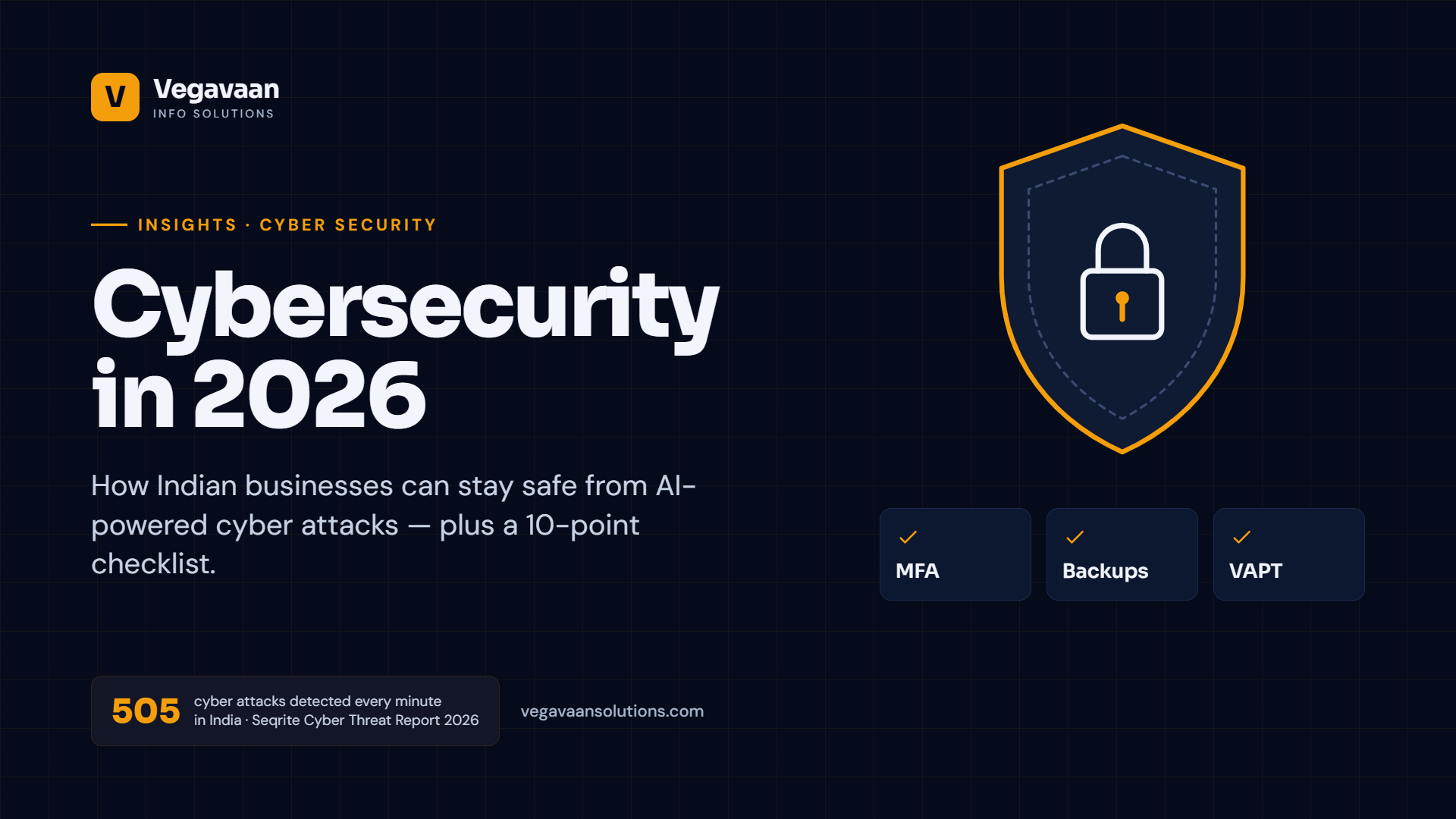
According to Seqrite's India Cyber Threat Report 2026, security systems monitoring more than 8 million endpoints in India recorded about 265 million cyber attack detections between October 2024 and September 2025 — roughly 505 attacks every minute.
- Trojans and file-infecting malware made up close to 70% of the attacks observed.
- Education, healthcare and manufacturing together accounted for nearly half of all detections.
- Maharashtra, Gujarat and Delhi were the most targeted states, with Mumbai, New Delhi and Kolkata leading among cities.
- Attackers ran millions of scans looking for unpatched software such as outdated WordPress plugins and web servers.
The message is clear: if your business is connected to the internet, it is already being tested by attackers every day.
Top cyber threats for businesses in 2026
1. AI-powered phishing
Phishing emails used to be easy to spot because of poor grammar and odd formatting. With generative AI, attackers now write convincing, personalised emails in perfect English or Hindi — often referencing real vendors, invoices or colleagues.
2. Deepfake voice and video fraud
Criminals can clone a person's voice from a short audio clip. A "call from the MD" asking accounts to urgently transfer money to a new vendor is one of the fastest-growing fraud patterns.
3. Ransomware
Ransomware locks your files and demands payment to unlock them — and increasingly threatens to leak your data as well. For a small business, a few days of downtime can mean lost orders, missed salaries and damaged trust.
4. Website and plugin exploits
Outdated CMS platforms, plugins and themes are an easy entry point. Attackers use automated tools to find and exploit known vulnerabilities within hours of them becoming public.
5. Stolen passwords and account takeover
Reused or weak passwords — especially on email, cloud storage and admin panels — remain one of the most common ways attackers get in. Once inside one account, they move to others.
6. Cloud misconfigurations
Public storage buckets, open databases and over-permissive access keys can expose customer data without any "hack" at all. As more businesses move to AWS and Azure, configuration mistakes are a growing risk.
7. Insider and third-party risk
Ex-employees with active logins, vendors with too much access and unmanaged personal devices all widen your attack surface.
Why small and mid-sized businesses are the easiest targets
Many SMBs believe they are "too small to be targeted." In reality, attackers prefer them because they usually have:
- No dedicated security team or monitoring
- Outdated websites, software and operating systems
- Shared or weak passwords and no multi-factor authentication
- Irregular or untested backups
- Little or no staff awareness training
Automated attack tools do not care about company size — they simply look for the easiest door to open.
The 10-point cybersecurity checklist for 2026
You do not need a huge budget to dramatically reduce your risk. Start with these ten steps:
- Turn on multi-factor authentication (MFA) for email, cloud, banking, admin panels and remote access — everywhere it is available.
- Update everything regularly. Patch operating systems, browsers, your website CMS, plugins and server software. Remove plugins you do not use.
- Follow the 3-2-1 backup rule. Keep 3 copies of important data, on 2 different types of storage, with 1 copy offline or off-site — and test that restores actually work.
- Train your team. Run short, regular cybersecurity awareness sessions and simulated phishing tests. People are your first line of defence.
- Verify payment requests by a second channel. Any request to change bank details or make an urgent transfer should be confirmed by calling a known number — never by replying to the same email or message.
- Use a password manager and unique, strong passwords for every account.
- Apply least-privilege access. Give people and vendors only the access they need, and remove access immediately when someone leaves.
- Protect every endpoint. Use modern endpoint protection (EDR/anti-ransomware) on laptops, desktops and servers.
- Get a security audit (VAPT). A Vulnerability Assessment and Penetration Test of your website, apps and cloud finds weaknesses before attackers do.
- Have an incident response plan. Decide in advance who to call, how to isolate systems and how to communicate if something goes wrong. Note that in India, certain cyber incidents must be reported to CERT-In within 6 hours of being noticed.
Compliance: the DPDP Act raises the stakes
India's Digital Personal Data Protection (DPDP) Act, 2023 requires businesses that handle personal data to take reasonable security safeguards to prevent data breaches. A breach is no longer just a technical problem — it can mean regulatory penalties and serious damage to customer trust. Good security practices are now also good compliance practices.
How AI can help defenders too
AI is not only a weapon for attackers. Used well, it helps businesses defend themselves by:
- Detecting unusual login patterns and suspicious transactions in real time
- Filtering phishing emails before they reach inboxes
- Summarising security alerts so small IT teams can focus on what matters
- Automating routine checks such as patch status and access reviews
How Vegavaan can help
At Vegavaan Info Solutions, our cyber security services help businesses find and fix weaknesses before attackers do. We offer:
- Security audits and VAPT for websites, mobile apps, APIs and cloud
- Secure coding and hardening for new and existing applications
- Cloud security reviews for AWS and Azure environments through our cloud computing team
- AI-powered monitoring and automation for faster threat detection
👉 Book a free security consultation and we will review your current setup and share a clear, prioritised action plan.
Frequently asked questions
What is the biggest cyber threat to businesses in 2026?
Malware such as trojans and ransomware remains the most common threat, while AI-powered phishing and deepfake fraud are the fastest-growing. Most attacks still begin with a phishing message, a weak password or unpatched software.
How can a small business improve cybersecurity on a low budget?
Start with free or low-cost steps: enable multi-factor authentication, keep software updated, use a password manager, keep offline backups and train staff to recognise phishing. These basics stop the majority of common attacks.
What is VAPT and does my business need it?
VAPT stands for Vulnerability Assessment and Penetration Testing. It is a structured security test that finds weaknesses in your website, apps, network or cloud. Any business that handles customer data, payments or online orders should consider it at least once a year and after major changes.
How often should employees get cybersecurity awareness training?
Short training sessions every quarter, plus occasional simulated phishing tests, work better than a single annual session. Threats change quickly, so regular reminders keep security top of mind.
Do Indian businesses have to report cyber attacks?
Yes. Under CERT-In directions, specified types of cyber security incidents must be reported to CERT-In within 6 hours of noticing them. Businesses handling personal data also have obligations under the DPDP Act.
Conclusion
Cyber attacks in India are happening at a scale of hundreds of attacks every minute, and AI is making them harder to spot. The good news is that most attacks can be stopped by getting the basics right: MFA, updates, backups, training and regular security testing.
This Cybersecurity Awareness Month, take the first step. Talk to a Vegavaan security expert today.
Source for statistics: Seqrite India Cyber Threat Report 2026, as reported by CRN India.